

How much should an influencer charge in 2026? The right price depends on your audience, average views, engagement quality, content format and the commercial rights a brand needs. A useful starting point is to calculate the value of your expected reach, account for production work and charge separately for advertising licences or exclusivity.
Whether you have 5,000 followers or 100,000, your rate card should explain what the brand receives and why your fee makes commercial sense.
Quick Summary
Influencer pricing in 2026 is best calculated using audience performance, production costs and clearly defined deliverables. Nano, micro and mid-tier creators can use the rate card below as a negotiating starting point, then adjust their quotation for engagement quality, audience relevance, paid usage rights and exclusivity.
2026 Influencer Rate Card: UK and US
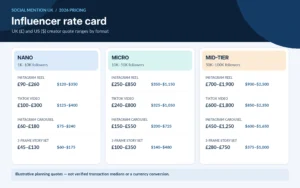
| Creator tier | Instagram Reel | TikTok video | Carousel | 3-Story set |
|---|---|---|---|---|
| Nano (1K–10K) | £90–£260 / 120–350 | £100–£300 / 125–400 | £60–£180 / 75–240 | £45–£130 / 60–175 |
| Micro (10K–50K) | £250–£850 / 350–1,150 | £240–£800 / 325–1,050 | £150–£550 / 200–725 | £100–£350 / 140–480 |
| Mid-tier (50K–100K) | £700–£1,900 / 900–2,500 | £600–£1,800 / 850–2,350 | £450–£1,250 / 600–1,650 | £280–£750 / 375–1,000 |
These are illustrative 2026 quotation ranges developed for this guide, not measured market averages or fixed industry prices. UK and US figures are separate planning estimates, not currency conversions. They assume one standard organic deliverable without extended paid advertising rights.
The ranges are informed by published creator-pricing discussions from Modash and Hootsuite. Their published benchmarks use different follower categories, formats and samples, so there is no single authoritative price for every creator.
1. The 2026 Baseline Pricing Formula (Base Rate + Engagement Multiplier)
A practical influencer pricing formula starts with the higher of your production minimum and the estimated value of your organic reach. You can then adjust for demonstrably strong engagement or audience fit. Commercial licensing and exclusivity should be calculated separately from the original content fee.
How to calculate your base rate
Use the following working formula:
Base Rate = Higher of (Production Minimum, Expected Views ÷ 1,000 × Target CPM)
Then calculate:
Adjusted Creative Fee = Base Rate × Performance and Audience-Fit Multiplier
CPM means cost per thousand impressions or views, depending on the measurement being used. It provides a useful way to estimate the value of reaching a relevant audience.
For instance, suppose a US technology creator averages 18,000 views per comparable Reel and uses a target CPM of $25.
18,000 ÷ 1,000 × $25 = $450
If the creator can justify a 10% premium through consistent audience engagement and strong brand relevance, the proposed creative fee becomes $495, potentially rounded to $500.
The 10% adjustment is a negotiating assumption, not an industry-wide standard.
Modash’s 2026 influencer CPM guidance offers these estimated ranges:
| Content format | Modash’s indicative CPM |
| Instagram Reels | 15–45 |
| Instagram Stories | 20–50 |
| TikTok videos | 7–25 |
Modash explicitly describes these benchmarks as experience-based estimates rather than findings from a large quantitative study.
Account for the work behind the content
CPM should not be your only pricing method. A professionally filmed Reel may require scripting, travel, shooting, editing, revisions and communication with the brand.
Establish a production minimum that covers your time and costs. When using an all-inclusive influencer CPM, avoid adding the same production costs again without justification.
Creators who are still launching their career as a paid micro-influencer should begin recording their production time, average views, audience demographics and previous sponsorship results. These details make future quotations easier to justify.
2. Rate Breakdown by Follower Tier (Nano, Micro & Mid-Tier)
Influencer rates generally increase with audience size, but follower count does not determine what a brand should pay. Content format, niche relevance and recent organic performance can make two creators in the same tier quote very different prices.
The rate card separates Instagram Reels, TikTok videos, carousels and Story sets because each provides a different mix of production effort, visibility and audience interaction. These are practical starting ranges, and creators should replace them with their own performance-based figures as they gather campaign results.
Nano-influencers: 1,000–10,000 followers
Nano-influencers can be attractive to businesses looking for specific local communities or tightly defined interests.
An independent skincare creator with 6,000 relevant followers may offer more useful product exposure to a local beauty business than a larger account whose audience is spread across unrelated countries.
Nano creators should price according to the following considerations:
- Recent views and interactions from comparable organic posts.
- The share of their audience located in the advertiser’s target market.
- The amount of content production required.
- The commercial value of the niche and product category.
A creator with only 5,000 followers can still negotiate a meaningful fee when the brand is buying credible content and access to a relevant audience.
Micro-influencers: 10,000–50,000 followers
Micro-influencers often have enough audience history to present a credible media kit, while retaining a recognisable relationship with their community.
For a creator with 25,000 followers, a proposed $500 Instagram Reel might be reasonable if previous comparable videos consistently attract meaningful views and interactions from the brand’s target customers.
Higher quotations are easier to justify when supported by recent analytics, previous partnership outcomes and a clear creative concept.
Micro creators can also offer brands a useful combination of Reels for discovery and Stories for follow-up actions, including website visits or product enquiries.
Mid-tier influencers: 50,000–100,000 followers
Mid-tier creators may receive larger campaign briefs requiring detailed scripts, professional editing, approval stages and multiple promotional placements.
Brands may also expect audience reporting, delivery deadlines and a more formal licensing agreement.
Higher follower counts do not automatically justify the upper end of a pricing bracket. A creator with 80,000 followers but inconsistent views should compare their quotation against what their content actually delivers.
Why different content formats command different rates
Instagram Reels and TikTok videos frequently involve more production than a single static post. Carousels may require detailed design, photography or educational content, while Stories are typically shorter-lived.
A three-frame Story package should have its own clearly defined fee rather than being treated as an unlimited addition to a Reel.
For creators, the best rate card prices the actual deliverable, including its expected audience exposure, creative workload and intended use.
3. Usage Rights, Whitelisting, and Exclusivity Surcharges (+30% to +50%)
Usage rights, whitelisting and exclusivity are separate commercial permissions that may increase an influencer’s total fee. A 30%–50% addition can be a useful opening negotiation range for limited advertising rights, but the appropriate charge depends on duration, territory, access and restrictions.
Organic publication allows the creator to post sponsored content on their own account. Paid usage rights allow the advertiser to use agreed content in advertising. Whitelisting, commonly called partnership advertising or creator authorisation, involves permitted advertising activity connected to the creator’s account or content.
These permissions should not be assumed to be included in the original creative fee.
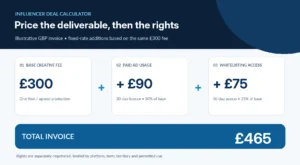
Example: Calculating a £465 influencer invoice
| Invoice item | Calculation | Fee |
| Base Reel production and organic publication | Fixed quotation | £300 |
| 30-day paid advertising licence | 30% of £300 | £90 |
| 30-day whitelisting access | 25% of £300 | £75 |
| Total | £465 |
Both percentage additions are calculated independently from the £300 creative fee. This is an illustrative contractual quotation, not a mandatory industry tariff.
What should the usage-rights agreement specify?
A creator should establish where the brand can use the content, for how long, in which territories and whether editing or sublicensing is permitted.
Thirty days of paid advertising is a different commercial arrangement from unrestricted perpetual usage.
Similarly, using a finished video in advertisements is not automatically the same as being authorised to promote that video through the creator’s identity.
For example, TikTok’s official Spark Ads guidance explains how advertisers can use organic creator posts with authorisation.
How much should category exclusivity cost?
Exclusivity means agreeing not to promote competing brands for a specified period.
A creator might consider an additional fee of 20%–50% of the creative rate for a narrowly defined, short exclusivity period, but this is a negotiation example rather than a verified standard.
A three-month restriction covering an entire product category could require considerably more compensation than a two-week restriction involving one directly competing brand.
The fee should reflect the genuine sponsorship opportunities the creator would be unable to accept.
4. How Engagement Ratios Dictate Your Pricing Power
Engagement ratios help influencers explain the quality of audience interaction rather than relying exclusively on follower totals. Creators with consistently strong organic engagement, relevant viewers and useful campaign outcomes can often negotiate towards the upper end of a pricing range.
A common follower-based engagement calculation is:
Engagement Rate (%) = (Average Engagements ÷ Followers) × 100
For example, a creator with 16,000 followers receiving an average of 768 relevant interactions per comparable post has a 4.8% follower-based engagement rate.
The interactions included in the calculation should be clearly defined. Likes and comments alone produce a different figure from likes, comments, shares and saves combined.
Illustrative mini case study: From $150 to a $525 package
A hypothetical US technology creator has 16,000 followers and previously quotes $150 for one sponsored Instagram Reel, without any separate licence fee.
The creator’s recent organic posts average a 4.8% follower-based engagement rate. After reviewing production work, audience insights and campaign deliverables, the creator develops three packages rather than quoting a single flat rate.
The proposed middle package includes one Reel for $300, three Story frames for $105 and a 30-day paid advertising licence for $120.
The package quotation totals $525, equivalent to 3.5 times the original $150 quotation.
This is an illustrative pricing comparison, not a documented completed negotiation. The increase reflects additional deliverables, licensing and revised creative pricing rather than a proven rise in audience performance.
What engagement evidence should you present to brands?
Include recent performance from comparable posts, supported by platform analytics. Average views, reach, audience location, saves, meaningful comments, clicks and attributable conversions can all help justify a higher rate.
Modash’s cost-per-engagement guide defines CPE as total campaign cost divided by total engagements.
For example, a $600 campaign that produces 1,500 measured interactions has a CPE of $0.40.
But a low CPE does not automatically mean strong sales performance. Brands should evaluate the metric alongside their actual campaign objective.
Some creators exploring commercial engagement tools may encounter commanding premium rates via SoldOutX influencer services or offers to maintain high post like counts on SoldOutX. These links describe commercial engagement services rather than independently verified sponsorship results.
When quoting brands, distinguish any purchased interactions from genuine audience engagement. Sponsored pricing should be supported by representative organic analytics and authentic commercial outcomes.
5. How to Pitch Multi-Post Bundles and Negotiate Against Lowball Offers
Influencer bundles combine several deliverables into one commercially useful campaign rather than simply offering a cheaper price per post. A Reel, three Stories and a defined advertising licence can give brands multiple audience touchpoints while increasing the creator’s total project value.
Build a three-tier sponsorship menu
An illustrative micro-creator rate card could offer:
| Package | Deliverables | Proposed fee |
| Essential | 1 Reel, organic posting only | $300 |
| Growth | 1 Reel + 3 Stories + 30-day paid usage rights | $525 |
| Campaign | Growth package + two edited cutdowns + agreed 30-day category exclusivity | $825 |
These example prices are not actual marketplace transactions. Final quotations should reflect audience performance, production costs and the exact contractual scope.
The middle package gives a brand more than a single piece of content without requiring a large campaign commitment.
A Reel can introduce a product, while Stories can provide additional context, answer common questions and direct interested viewers towards the advertiser.
How to respond to a low brand offer
Suppose a brand offers £200 for a project that normally costs £450.
Instead of immediately lowering the fee for identical work, negotiate the scope.
You might offer a simpler Reel with fewer production requirements at the lower price, while keeping the full Reel-and-Stories package at your normal quotation.
If the brand also requires paid advertising rights, include the relevant licence fee rather than quietly absorbing the extra commercial value.
This approach protects your pricing structure and gives the advertiser a genuine choice.
What should your rate card include?
A professional media kit or sponsored post pricing guide should make the commercial arrangement easy to understand.
Include your core deliverables, starting fees, average organic performance, audience geography, production expectations and additional rights charges.
Your agreement should also cover payment terms, content approvals, reasonable revision limits, publication dates and how long sponsored material must remain live.
For UK campaigns, review the ASA’s influencer advertising guidance. US creators should consult the FTC’s disclosure guidance so paid partnerships are identified appropriately.
Clear terms reduce misunderstandings and make your quotation more credible.
Frequently Asked Questions
1. How much should an influencer with 10,000 followers charge per post?
An influencer with 10,000 followers might quote approximately £250–£850 or 350–1,150 for an Instagram Reel under this guide’s illustrative micro-creator ranges. The final amount depends on average organic views, engagement quality, production requirements and audience relevance.
2. What is the standard formula for calculating influencer rates in 2026?
There is no universal standard formula. A practical method divides expected organic views by 1,000 and multiplies the result by a target CPM, subject to a production minimum. Audience-fit adjustments and separately negotiated commercial rights determine the final quote.
3. How much extra should you charge a brand for paid ad usage rights?
A limited 30-day advertising licence might be quoted at 30%–50% above the base creative fee as an initial negotiating range. Longer durations, additional territories, extensive editing permissions or broad campaign distribution may justify a larger separately negotiated charge.
4. Do UK influencers charge different rates than US creators?
Yes. UK and US influencer pricing can differ because of local market conditions, audience geography, creator demand and production costs. Compare quotations within the relevant market instead of treating a US dollar rate card as a direct currency conversion.
5. Can a creator with 5,000 followers charge more than one with 20,000 followers?
Yes. A creator with 5,000 highly relevant and engaged followers may justify a higher fee than a larger account with inconsistent performance. Audience location, content quality, demonstrated conversions and production requirements can matter more than follower count alone.
Final Verdict
Influencer marketing pricing in 2026 should reflect the value of the complete brand collaboration, not just the number of followers on an account.
Start with a realistic creative fee, validate it against recent organic performance, then add separately priced advertising rights and other commercial requirements.
A clear rate card with transparent deliverables and properly defined contracts gives creators stronger negotiating leverage while helping brands understand exactly what they are paying for.

Discussion