

Quick summary
A micro-influencer is a creator with roughly 1,000 to 50,000 followers and an engaged, niche audience. Getting paid means building that audience, keeping engagement around 3% to 5%, and pitching brands with a one-page media kit.
Rate snapshot: UK creators at this level often quote around £100 to £500 per Reel, while US creators commonly quote $150 to $600. Rates vary by niche and engagement, so check current figures in the Influencer Marketing Hub micro-influencer report.
What Qualifies You as a Micro-Influencer in 2026?
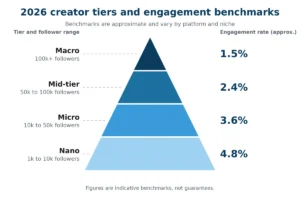
In 2026, a micro-influencer usually has between 1,000 and 50,000 followers. Brands value them because their audiences are often more specific and responsive than those of celebrities. Follower count is not enough; engagement and niche focus matter just as much.
Micro-influencers are usually split into two bands. Nano creators have roughly 1,000 to 10,000 followers, and micro creators have roughly 10,000 to 50,000. The band matters less than what happens inside it. A 4,000-follower account where viewers comment and save posts can be more useful to a brand than a 40,000-follower account with thin engagement, because brands are buying attention and trust, not just reach.
Engagement generally falls as audiences grow. Influencer Marketing Hub’s micro-influencer research reports that micro-influencers can generate up to 60% higher engagement than macro-influencers and celebrities. Benchmarks vary by platform and niche, so treat tier rates as directional. The figures used in this guide are roughly 4.8% for nano creators, 3.6% for micro creators, 2.4% for mid-tier accounts and 1.5% for macro accounts.
Step 1: Select a High-Demand Niche and Optimize Your Profile SEO
Pick one niche you can sustain for years and state it plainly in your bio. Brands search for creators by topic, so a clear bio, handle and location make you easier to find. Tech, beauty, finance, fitness and UK lifestyle often attract larger brand budgets.
Niche choice is a commercial decision as much as a creative one. Test each option against three questions. Can you produce useful content in it for at least a year? Do brands sell products that this audience would buy? Would a stranger understand what you post within three seconds of reading your bio? If the answer to any of these is no, narrow or change the niche before you spend months building an audience around it.
Profile SEO is simpler than most people think. Search on Instagram and TikTok draws on usernames, display names, bios, captions and on-screen text, so use the phrases your audience would type, such as UK sustainable fashion or vegan skincare tips. Keep them natural. A bio that reads like a keyword list puts people off. For a fuller walkthrough of keyword placement, see our Instagram SEO optimization guide.
Step 2: Master Short-Form Video (Reels & TikTok) and Carousels
Short-form video is the easiest route to new viewers for most creators starting out, so Reels and TikTok should carry most of your output. Use carousels for detail people want to save, such as checklists and step-by-step tips, and treat them as a second format rather than a replacement.
Plan with a 9-grid. Map nine posts in a three-by-three grid, mixing three educational posts, three behind-the-scenes or personal posts and three proof posts such as results, reviews or collaborations. The mix keeps your feed useful and shows brands the kind of content you produce. Review the grid monthly and replace any format that consistently gets little response.
Open each video with a clear promise in the first two seconds, add on-screen text that works without sound, and write captions that include the phrase you want to be found for. Consistency matters more than volume at this stage. Three to four well-planned posts a week is a realistic rhythm for someone with a day job, and steadier than a burst of ten posts followed by silence. Formats and algorithms change quickly, so test rather than copy, and use your own analytics to see which hooks hold attention.
Step 3: Build Baseline Social Proof and Reach 5K Followers
Before a brand pays, it wants proof that your audience is real and responsive. Around 5,000 followers is a milestone many brands notice, but consistent comments, replies and saves matter more than the number alone.
Start with organic growth. Reply to comments within the first hour of posting, collaborate with creators of a similar size, and join the conversations where your niche already gathers. These habits create the early proof brands look for: a steady stream of genuine interaction that shows people trust what you say.
Some creators also look at paid growth services to reach a starting audience faster. SoldOutX offers influencer growth services, and its follower packages are one option. Be realistic about the trade-offs. Purchased followers rarely comment or save, which pulls down the engagement rate brands check. Platforms also treat inauthentic activity as a policy problem, so bought audiences can be removed in clean-ups. Use paid growth alongside strong content, not instead of it.
Case study: a UK sustainable fashion creator
A UK sustainable fashion creator was stuck at 1,900 followers, and brands offered only free gifted socks instead of paid partnerships. The creator used SoldOutX influencer packages to grow to 5,800 followers while maintaining 250-plus likes and around 20 comments per Reel. With that baseline in place, they pitched 15 ethical clothing brands using a one-page media kit. Three of those pitches closed as paid Reel deals at £250 each within 21 days.
The takeaway is to pair any audience growth with a media kit and a list of brands to pitch, so the new reach turns into deals rather than just a bigger number.
Step 4: Calculate and Protect Your 3%–5% Engagement Rate
Engagement rate measures how many followers interact with a post, calculated as interactions divided by followers, multiplied by 100. For micro-influencers, a rate of 3% to 5% is a practical target that signals an audience that responds rather than scrolls past.
Platforms rarely display engagement rate directly, so you will usually calculate it yourself. Add up likes, comments and saves on a post, divide by your follower count and multiply by 100. Suppose a Reel from an account with 10,000 followers gets 300 likes, 20 comments and 30 saves. That is 350 interactions, so the engagement rate is 3.5%. Different tools calculate the rate differently, some using reach or impressions instead of followers, so compare figures only within the same tool and over time.
Protecting your rate is mostly about audience quality. Be selective about who you follow back, avoid giveaways that attract people who will never buy, and review posts that bring views but few interactions. A sudden drop after a follower spike is a warning sign that your new audience is not engaged. Treat the 3% to 5% range as a working target rather than a rule, because smaller accounts often post higher rates and strong performance depends on your niche.
Step 5: Design a 1-Page Media Kit and Pitch Brands (With Script)
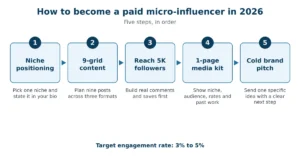
A media kit is a one-page document that shows your niche, audience, engagement rate, past collaborations and rates. Send it with a short, specific pitch to brands that already work with creators in your niche, and suggest a clear next step.
Your media kit should answer the questions a brand asks in its first minute: who you are, who follows you, how they engage and what working with you looks like. Include your niche, audience location and age range if you have the data, your engagement rate, two or three past collaborations or sample posts, your contact details and a rate range. Keep the layout simple. A brand should be able to scan it on a phone in under a minute.
Set your rates from evidence rather than guesswork. Your engagement, the demand in your niche and the extras you deliver, such as stories, usage rights or whitelisting, should all shape the price. Price usage rights separately, because a brand that reuses your content in paid ads is buying more than a single post.
Pitch directly and personally. Send a short email or direct message that names the brand, explains one concrete idea and asks for a specific next step. Here is a template to adapt:
Subject: Reel idea for [Brand]
Hi [Name],
I create [niche] content for [audience, for example UK readers interested in sustainable fashion]. My recent posts average a [X]% engagement rate, and my one-page media kit is attached.
I have a Reel idea that fits [product or campaign]: [one-line concept]. Would you be open to a 15-minute call next week?
Thanks, [Name] [Profile link]
Label every paid post clearly with a disclosure such as #ad or a paid partnership tag, because the UK’s Advertising Standards Authority influencer guide and the US FTC’s Disclosures 101 guide both expect disclosures to be clear and hard to miss. Creator marketplaces can also help brands find you, but some take a commission or fee, so compare terms before joining. Use them to supplement direct outreach rather than replace it.
Frequently Asked Questions
How many followers do you need to become a paid micro-influencer?
There is no official minimum. Creators are generally considered micro-influencers from about 1,000 followers, and many brands also value a responsive audience of around 5,000. Engagement and niche fit often matter as much as the count.
How much do micro-influencers make per post in the UK and US?
Rates depend on niche, engagement and deliverables. As a rough benchmark, UK creators often quote £100 to £500 per Reel and US creators $150 to $600. Treat these as starting points, and price usage rights and extra deliverables separately.
Can you get paid brand deals with under 5,000 followers?
Yes. Nano creators with under 5,000 followers do land paid deals, especially with local brands and niche companies that value a specific audience. Strong engagement, a clear niche and a professional media kit often matter more than follower count at this stage.
What engagement rate do brands look for when hiring micro-influencers?
Many brands look for an engagement rate of around 3% to 5% for micro-influencers, though expectations vary by niche and platform. Smaller accounts tend to show higher rates than larger ones. Consistent engagement across recent posts carries more weight than one strong result.
How long does it take to land your first paid brand sponsorship?
There is no fixed timeline. Creators who post consistently, build a media kit and pitch regularly can land a first paid deal within a few months, though it may take longer. Timing depends on niche competition and how many brands you pitch.
Final Verdict
Becoming a paid micro-influencer comes down to a clear niche, consistent short-form video, a healthy engagement rate and a media kit you can send to brands. Follower count helps, but brands pay for proof that you can deliver.
The five steps work best as a system rather than a checklist. Your niche decides which brands fit, your content builds the engagement that proves your audience is real, and your media kit turns that proof into a pitch. Growth tools can speed up the early stage, but they only pay off when the content and outreach are already in place.
Start this week with Step 1. Write your niche in one sentence, rewrite your bio to match it, and list five brands that already work with creators in that space. Then pitch the first one.

Discussion