
 By Oliver Sterling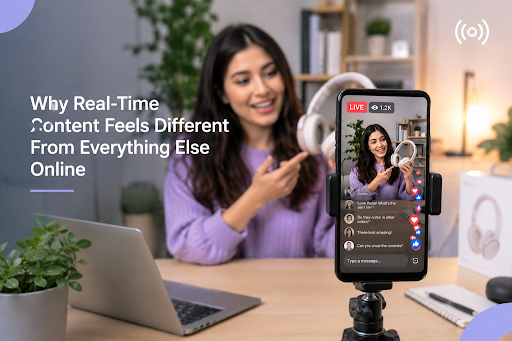
A recorded video can be paused, skipped, replayed, or watched whenever a viewer chooses. A live experience works differently. It happens at a particular moment, and viewers know that what they are watching is unfolding in real time.
That simple difference can change how people pay attention to content. A live broadcast can create anticipation, encourage immediate reactions, and make viewers feel connected to other people experiencing the same event.
The growing popularity of live video suggests that audiences are not simply looking for more content. They are increasingly interested in experiences that allow them to participate, respond, communicate, and sometimes even influence what happens next.
This shift can be seen across entertainment, gaming, education, creator communities, events, and ecommerce. But what exactly makes real-time content feel different from everything else online?
The Growth of Real-Time Video
The scale of online video consumption provides useful context for understanding this shift.
In Q4 2025, viewers watched more than 30 billion hours of livestreamed content globally, according to Streams Charts. Its Q3 2025 report had already recorded 29.45 billion hours, showing how substantial the global live-video ecosystem has become.
Traditional streaming has also become a major part of everyday media consumption. Nielsen reported that streaming accounted for 44.8% of total U.S. television usage in May 2025, exceeding the combined share of broadcast and cable for the first time in its monthly measurement.
These numbers cover broader streaming and livestreaming activity rather than one particular platform. However, they illustrate a larger change in how audiences consume video: digital viewing is no longer limited to scheduled television or prerecorded content.
What Makes Real-Time Content Different?
The defining characteristic of live content is immediacy.
When someone watches a recorded video, the content already exists in its final form. A live broadcast, by contrast, develops while the audience is present.
A creator may answer a viewer’s question, change the direction of a discussion, demonstrate something based on audience requests, or respond to an unexpected event.
This creates a two-way relationship that is difficult to reproduce through completely static content.
A live streaming platform can bring video, chat, reactions, notifications, moderation, and other interactive features together in one environment.
Technology is important, but the experience is ultimately shaped by what viewers can do while the broadcast is happening.
The Audience Becomes Part of the Experience
One reason live content can feel more engaging is that viewers can participate while the content is happening.
A comment posted during a livestream may receive an immediate response. A viewer might vote in a poll, ask a question, react to a demonstration, or communicate with other people watching the same broadcast.
This changes the traditional relationship between creator and audience.
Instead of:
Creator → Content → Viewer
the experience can become:
Creator ↔ Content ↔ Audience
That distinction matters because participation can give viewers a stronger sense of presence.
It also explains why live video can work well for creator communities, gaming, interviews, product demonstrations, auctions, conferences, and other experiences where interaction is part of the value.
Real-Time Interaction Creates a Sense of Presence
There is also a social element to live content.
Knowing that other people are watching at the same time can create a feeling of shared presence. Viewers may not know one another personally, but they are experiencing the same event simultaneously.
This is particularly relevant to events where timing matters.
A product launch, sports discussion, gaming tournament, creator session, or live interview has a different character when people are experiencing it together rather than watching a recording independently.
The value therefore comes from more than the video itself. Timing, interaction, and participation become part of the content.
Live Shopping Shows How Content and Commerce Can Merge
One of the clearest examples of real-time interaction changing digital behavior is live shopping.
Traditional ecommerce generally separates product discovery from purchasing. A customer browses a product page, reads information, compares options, and completes checkout.
Live shopping combines these activities with real-time video.
A host can demonstrate a product, answer questions, respond to comments, and guide viewers toward a purchase during the same session.
Recent data shows that this behavior is becoming increasingly relevant. EMARKETER forecast that 21.7% of U.S. digital buyers would make a purchase through livestream shopping in 2025.
Statista also estimated that approximately 49 million U.S. consumers would use live commerce in 2025, with the number expected to exceed 60 million over the following three years.
The format is particularly interesting because it combines three activities that were traditionally separate:
Entertainment + Interaction + Commerce
This is why concepts such as a Whatnot Clone are often discussed in the context of live-commerce development. The broader model involves livestreaming combined with product discovery, seller interaction, auctions or demonstrations, and purchasing.
The important lesson is not simply to replicate an existing platform. It is to understand why combining real-time communication with commerce can change the shopping experience.
Why Timing Can Influence Viewer Behavior
Live content also introduces a form of natural scarcity.
A recorded video can usually be watched tomorrow, next week, or next month. A live event has a specific starting point and duration.
That can encourage viewers to attend at a particular time instead of postponing consumption indefinitely.
This does not mean every livestream needs artificial urgency. Scheduled events already have a natural reason for simultaneous participation.
The psychological difference is simple:
Recorded content says: “Watch whenever you want.”
Live content says: “Something is happening now.”
That distinction can influence how people decide when and whether to participate.
Live Content Can Create Stronger Community Experiences
A livestream can also function as a meeting point for a digital community.
Creators who regularly broadcast at predictable times can establish recurring experiences. Viewers may recognize familiar usernames, participate in conversations, and develop shared references around the content.
This community effect can extend beyond the stream itself.
A live broadcast may lead to:
- Discussions in online communities
- Short video clips
- Social media conversations
- Follow-up content
- Fan-created material
- Repeat viewing sessions
In other words, the livestream can become the starting point for a wider content ecosystem.
Moderation Becomes More Important in Live Environments
The interactive nature of live content also creates challenges.
A recorded video can be reviewed and edited before publication. A live broadcast happens while the audience is watching.
Comments, questions, reactions, and user-generated contributions can appear within seconds.
That makes moderation considerably more complicated.
A modern live-video service may need tools for:
- Comment moderation
- User reporting
- Blocking and muting
- Spam detection
- Content monitoring
- Host controls
- Audience management
These features are not simply technical extras. They can influence whether viewers feel comfortable participating.
As live platforms grow, moderation needs to operate at the same speed as the content itself.
Technology Has to Work in Real Time
Live video also creates technical challenges that are less prominent in traditional prerecorded media.
Latency is one example.
If there is a significant delay between the broadcaster and the viewer, conversations can become disconnected. A viewer may ask a question after the host has already moved to another subject.
Scalability is another challenge.
A broadcast may begin with a few hundred viewers and suddenly attract thousands. The underlying infrastructure needs to handle changes in demand without significantly affecting the viewing experience.
Other technical considerations include:
- Adaptive video quality
- Content delivery
- Authentication
- Video encoding
- Infrastructure scalability
- Analytics
- Monitoring
- Security
For businesses exploring this space, companies such as Triple Minds are one example of technology providers operating in the broader digital-product and development ecosystem. However, the technical requirements themselves apply across the wider live-video industry.
Personalization Is Changing How Viewers Discover Live Content
As the number of live broadcasts increases, discovery becomes another challenge.
A viewer may have access to hundreds or thousands of simultaneous streams. More content does not automatically mean better discovery.
Recommendation systems can help organize this volume by considering factors such as:
- Viewing history
- Followed creators
- Categories
- Engagement behavior
- Search activity
- Current popularity
- Previous interactions
However, personalization also introduces questions about transparency and user control.
If an algorithm determines which live broadcasts receive the most visibility, its recommendations can influence the distribution of attention.
That makes discovery an important part of the overall live-streaming experience rather than simply a search feature.
Real-Time Content Is Moving Beyond Entertainment
Live video is no longer limited to gaming or entertainment.
Organizations are using live experiences for education, conferences, product launches, professional events, demonstrations, training, customer communication, and community building.
The common factor is the opportunity for immediate interaction.
A teacher can answer questions during a lesson. A company can demonstrate a product while customers ask questions. A creator can communicate directly with an audience. A conference can connect remote attendees with speakers in real time.
This flexibility is one reason live video continues to expand into different industries.
The Live-Commerce Opportunity Is Growing
Live commerce provides a particularly useful example of where real-time video can go next.
According to EMARKETER’s January 2026 analysis, U.S. livestream ecommerce sales were forecast to reach $14.64 billion in 2025, representing nearly 50% growth, while the number of buyers was expected to increase by 21.5%.
At the same time, adoption is not universal.
A 2025 Savings.com survey found that about 60% of U.S. adults had watched live shopping shows, while around 33% had made purchases through the format.
That distinction is important.
Large audience numbers do not automatically mean that every viewer becomes a buyer. The success of live commerce depends on factors such as product relevance, trust, host quality, demonstrations, pricing, checkout convenience, and the overall viewing experience.
Real-Time Content Is Not Automatically Better
It is tempting to assume that live content will eventually replace prerecorded video.
That is unlikely.
Recorded content offers convenience, editing, accessibility, and flexibility. It works particularly well when viewers want to learn at their own pace or consume information according to their own schedule.
Live content serves a different purpose.
Its strength comes from immediacy and participation.
The most effective digital experiences may therefore combine both formats. A live event can generate a recording, short clips, discussion points, product pages, and follow-up content that remain useful after the broadcast ends.
What the Future of Live Content Could Look Like
The next stage of live video is likely to focus less on simply increasing the number of livestreams and more on improving the experience around them.
That could include better personalization, lower latency, stronger moderation, richer audience interaction, integrated commerce, improved discovery, and more sophisticated tools for creators.
The broader direction is already visible in live commerce, where entertainment, social interaction, and purchasing are increasingly connected. Statista describes live commerce as a two-way digital experience that combines video with real-time interaction and purchasing.
This suggests that the future of live video may not be defined by video alone.
Instead, the platform surrounding the video may become just as important as the broadcast itself.
Final Thoughts
Real-time content feels different because it introduces something prerecorded media cannot fully reproduce: the feeling that an experience is happening now, with other people, and that participation is possible.
The growth of livestreaming, the expansion of live commerce, and the increasing importance of interactive digital experiences all point toward a broader shift in online behavior.
But the future is not necessarily about choosing between live and recorded content.
It is about understanding what each format does best.
Recorded media provides flexibility. Live media provides immediacy. Interactive platforms combine those qualities with communication, community, discovery, and commerce.
As digital experiences continue to evolve, the most valuable question may no longer be simply “What should people watch?”
It may be:
“How can people participate in what they are watching?”
Frequently Asked Questions
What makes real-time content different from recorded content?
Real-time content happens while viewers are watching, allowing them to interact with creators, hosts, sellers, or other viewers during the experience. Recorded content provides greater flexibility but does not offer the same simultaneous participation.
Why are live streaming platforms becoming popular?
They combine video with real-time communication and audience interaction. This makes them useful for entertainment, gaming, education, events, creator communities, shopping, and other experiences where participation matters.
How does live streaming increase audience engagement?
Viewers can participate through comments, reactions, questions, polls, and other interactive features. Immediate responses can make audiences feel more connected to the content and the people creating it.
What is live shopping?
Live shopping combines livestreaming with ecommerce. Hosts or sellers demonstrate products during a broadcast while viewers can ask questions, interact with the presenter, and purchase products during or around the live session.
What is a Whatnot Clone?
A Whatnot Clone generally refers to a platform concept based on interactive live-commerce features such as livestreaming, seller profiles, product listings, auctions, real-time chat, and purchasing. It should be understood as a business or product model rather than permission to copy another company’s protected content, branding, or proprietary technology.
Why is latency important in live streaming?
Latency is the delay between an event occurring and the viewer receiving the video. Lower latency can make conversations, demonstrations, auctions, gaming, and other interactive experiences feel more immediate.
What features are important for a live streaming platform?
Common features include reliable video delivery, live chat, moderation tools, user profiles, notifications, content discovery, analytics, authentication, scalable infrastructure, and payment functionality where commerce is involved.
Is live streaming only useful for entertainment?
No. Live video can be used for education, conferences, product demonstrations, training, professional events, customer communication, shopping, and community building.
Is live streaming replacing recorded video?
Not necessarily. The two formats serve different purposes. Recorded content provides convenience and flexibility, while live content creates immediacy and participation. Many digital services can benefit from combining both.