

A social media sales funnel is a structured conversion system that moves strangers from algorithmic short-form discovery to repeat purchases using stage-specific content, visible social proof, and frictionless direct-message checkouts. While most UK and US brands treat Instagram, TikTok, and YouTube as broadcast billboards, revenue-generating accounts on Social Mention UK engineer every post to perform one distinct job: capturing cold attention, building authority, validating buyer trust in the comments, or triggering an immediate sale.
According to Sprout Social’s 2026 Social Media Statistics Report, social networks collectively drive over 60% of all product discovery surpassing Google’s 34.5% share while 85% of consumers state that a social video directly convinced them to buy a product or service. Yet follower counts alone rarely pay the bills. Modern buyers do not move in a straight line from a single viral clip to a credit card checkout; they loop across short-form feeds, inspect comment sections for peer validation, and abandon clunky external bio links the moment a page loads slowly. Below is the complete blueprint for building a high-converting social commerce funnel that turns passive scrollers into paying customers.
Quick Summary Box & Funnel Mapping Table
Quick Summary: A social media sales funnel converts cold viewers into paying buyers across four core stages: short-form video discovery, educational carousel nurturing, comment-section social proof validation, and automated direct-message checkout triggers that eliminate external browser friction and capture immediate purchase intent.
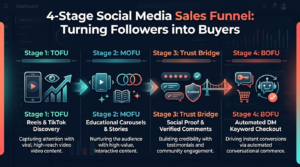
Modern buyers typically require between 5 and 8 distinct touchpoints across discovery feeds, comment sections, and private messages before completing a first-time purchase, according to Sprout Social funnel research and Sprout Social’s Proof of Reality Flywheel analysis. Mapping your content formats and conversion benchmarks to each stage prevents revenue leaks across the buyer journey:
| Funnel Stage | Primary Goal | Best Content Formats | Primary KPI | 2026 Conversion / Engagement Benchmark |
|---|---|---|---|---|
| Stage 1: Top of Funnel (TOFU) | Attract qualified non-followers via algorithmic search and discovery | 15–45s Instagram Reels, TikTok videos, YouTube Shorts | Non-follower reach, 3-second hook retention, profile visits | 3.70% average TikTok engagement rate; 1.5%–3.5% profile visit rate |
| Stage 2: Middle of Funnel (MOFU) | Warming up followers, build topical authority, and handle objections | 7–10 slide Carousels, daily interactive Stories, Broadcast Channels | Saves, shares, Story sticker taps, Broadcast poll votes | 0.48%–1.2% feed engagement rate; 5%–10% Story reply/tap rate |
| Stage 3: The Trust Bridge | Eliminate buyer scepticism through peer validation | Pinned customer comments, UGC stitched reviews, case study posts | Comment-to-like ratio, positive comment sentiment, review saves | 96%–97% of shoppers audit reviews and comments before buying |
| Stage 4: Bottom of Funnel (BOFU) | Convert warm engagement into leads and direct checkouts | Comment-to-DM keyword posts, Story link sequences, TikTok Shop / IG Shop | DM opt-in rate, checkout link CTR, cost per acquisition (CPA) | 12%–20% automated DM conversion rate vs. 2%–5% Link-in-Bio opt-in |
| Stage 5: Post-Purchase Retention | Turn first-time buyers into repeat customers and UGC creators | Automated DM onboarding, unboxing challenges, VIP Broadcast drops | Repeat purchase rate, UGC tag volume, customer lifetime value (LTV) | 78% re-purchase willingness after positive brand interaction |
Stage 1 (TOFU): Attracting Qualified Strangers with Short-Form Discovery
Top-of-funnel social discovery uses vertical short-form videos on Instagram Reels, TikTok, and YouTube Shorts to reach non-followers via algorithmic interest graphs, filtering for qualified prospects through problem-specific hooks and searchable captions rather than chasing broad, unmonetisable viral views.
When you are growing a brand on social media from zero, the biggest trap is optimising for raw view counts instead of buyer alignment. Whether you are scaling on Instagram, TikTok, or keeping pace with Facebook algorithm updates and growth strategies, a humorous lip-sync clip or generic trending audio reel might rack up 500,000 views, but if those viewers have zero interest in your core product category, your conversion rate down the funnel will flatline. Short-form video delivers the highest return on investment (41%) of any video format in 2026 according to Sprout Social’s video marketing benchmarks, provided every clip acts as a qualification filter.
Engineering 3-Second Problem Hooks and Social Search SEO
Algorithmic feeds on TikTok and Instagram evaluate watch time, completion rate, and share velocity before pushing a video to cold non-followers. Simultaneously, 21% of all online searches now occur directly inside social platforms rising to 41% among Gen Z users who search social networks before Google, as documented in Sprout Social’s Q2 2026 Pulse Survey. To capture both algorithmic distribution and high-intent social searchers, structure every TOFU video around three tactical mechanics:
- Call out the exact buyer pain point in the first 3 seconds: Replace vague intros (“Hey guys, today we’re talking about skincare”) with specific, symptom-first visual and spoken hooks (“If your vitamin C serum oxidises and turns orange before you finish the bottle, here is the formulation mistake costing you £45”).
- Embed prompt-matching search keywords across three layers: Place your primary problem phrase in the spoken audio (which auto-generates closed captions), the on-screen text banner, and the first two lines of your caption so platform search engines and AI answer engines index the clip accurately.
- Close with a micro-commitment profile bridge: Never ask cold viewers to buy a £200 coaching package or a $90 supplement bundle on their very first impression. Direct them to a low-friction next step, such as reading the caption breakdown, saving the checklist for later, or visiting your profile to view a pinned deep-dive series.
Stage 2 (MOFU): Warming Up Followers with Educational Carousels & Stories
Middle-of-funnel nurturing transforms casual profile visitors into warm leads using multi-slide educational carousels, interactive Instagram Stories, and Broadcast Channels that demonstrate topical authority, answer technical objections, and train followers to engage regularly with your brand before a sales pitch appears.
Once a cold viewer taps follow, they enter the consideration phase of your TOFU MOFU BOFU social media architecture. Short-form Reels win attention, but they rarely provide enough depth to dismantle complex purchasing objections around price, ingredients, ROI, or implementation time. If you only publish 15-second discovery clips, new followers remain lukewarm spectators who never develop enough conviction to buy.
Deploying Multi-Slide Carousels, Story Selling, and Broadcast Channels
To move followers from passive curiosity to active desire, rotate three high-retention nurturing formats across your weekly schedule:
- Publish 7-to-10-slide educational carousels to earn Saves and Shares: Carousels allow readers to consume frameworks, before-and-after breakdowns, and product comparisons at their own pace. Because algorithms weight Saves and Shares heavily as signals of lasting utility, a carousel that solves a specific workflow or styling problem keeps resurfacing in followers’ feeds for days.
- Run 4-frame interactive Story selling sequences three times a week: While feed posts reach a mix of cold and warm audiences, Stories speak directly to your most engaged followers. Use a structured four-frame sequence: Frame 1 states a common customer frustration; Frame 2 agitates the hidden cost of ignoring it with an interactive Poll sticker (“Dealing with this right now? Yes / Need the fix”); Frame 3 reveals your proprietary method or product mechanism; and Frame 4 invites viewers to tap a reaction sticker or reply with a keyword for the full resource.
- Funnel superfans into Instagram Broadcast Channels or WhatsApp Communities: Public feeds are subject to algorithmic fluctuations, whereas Broadcast Channels deliver push notifications straight to opted-in members’ inboxes. Use voice notes, behind-the-scenes product testing clips, and flash polls inside your channel to nurture your warmest 5%–10% of followers into first-in-line buyers.
Stage 3 (The Trust Bridge): How Social Proof Removes Buyer Hesitation
The social proof trust bridge eliminates mid-funnel buyer scepticism by curating active, verifiable comment sections, customer testimonials, and peer discussions on product posts, reassuring hesitant shoppers that real customers trust your brand before they commit to a purchase decision.
Competitor guides on how to convert followers to customers routinely skip what happens in the 30 seconds between a follower liking a product post and clicking the checkout link. In 2026, Sprout Social’s Pulse Survey shows that 83% of consumers encounter AI-generated content on social feeds at least sometimes, and 56% see it often or very often. Because polished brand graphics and AI copy are effortless to fake, prospective buyers have trained themselves to audit your comment section immediately. According to BrightLocal data cited by Sprout Social, 97% of consumers read online reviews and peer feedback before purchasing, and 73% of social users will abandon a brand for a competitor if the brand fails to respond in its comments or DMs.
When a warm prospect opens the comment thread on your flagship offer post and sees zero comments—or worse, unanswered complaints—buying momentum collapses instantly. An empty comment section signals that nobody is buying, triggering loss aversion right at the threshold of conversion. Conversely, an active thread filled with specific product questions, authentic customer experiences, and prompt brand replies serves as living buyer social proof. To overcome the “cold start” problem on high-stakes launch posts and conversion reels, many e-commerce brands and creators build high buyer trust with verified Instagram comments alongside organic community seeding, ensuring that new visitors encounter an active, credible discussion rather than a ghost town.
> Mini Case Study: Before vs. After Callout Box (118 Words)
- > Before: A UK online nutrition coach with 6,200 Instagram followers relied on a passive Link-in-Bio storefront, generating just 2 client inquiries per month despite posting four times weekly. High-intent Reels attracted thousands of views, but barren comment sections and six-click bio navigation caused severe prospect drop-off before checkout.
- > After: The coach replaced bio-link calls to action with an automated “Comment PLAN” DM trigger on client transformation carousels and seeded key programme posts with custom positive comments via SoldOutX to establish immediate buyer validation. Within 30 days, this updated funnel triggered 84 automated DM conversations, captured 59 qualified email leads, and closed 11 new £250 coaching clients—generating £2,750 in direct monthly revenue without spending a penny on paid ads.
Architecting a High-Trust Comment Section and Profile Audit Trail
To make your Trust Bridge watertight when prospects inspect your profile, combine proactive social proof management with strict authenticity guardrails:
- Pin three strategic comments to the top of every offer post: Pin one detailed customer testimonial describing a measurable outcome, one common pre-purchase FAQ answered clearly by your team, and one comment showing the exact keyword trigger in action.
- Accelerate initial engagement velocity on commercial launches: When launching a new SKU, coaching cohort, or seasonal offer, pairing organic VIP early-bird feedback with targeted SoldOutX social media growth services helps establish baseline engagement metrics (comments, saves, and story views) so the algorithm and human visitors recognise the post as active.
- Respect the material limitation of social proof seeding: Engagement boosts and seeded comments reduce initial friction and spark the bandwagon effect, but they cannot salvage a weak offer, slow shipping, or unresponsive customer care. Every comment—whether organic or seeded—must reflect accurate product capabilities, and a human team member must reply to real buyer questions within 2 to 4 hours to close the trust loop.
Stage 4 (BOFU): Closing Sales via Comment-to-DM Automation and Story Offers
Bottom-of-funnel conversion turns warm engagement into revenue using automated comment-to-DM keyword triggers, timed Story offer sequences, and native in-app checkouts that deliver direct purchase links inside private chat threads while buyer intent is at its highest peak.
For years, “Click the link in my bio” was the default call to action on social media. Today, it is the single largest conversion leak in most social commerce funnel setups. As documented in CreatorFlow’s 2026 Bio Link vs. DM Automation analysis, a Link-in-Bio path forces a mobile user through six separate steps: viewing the Reel, exiting the feed to visit your profile, tapping the bio URL, waiting for an external browser landing page to load, scanning 10 to 20 menu buttons to find the right item, and finally clicking through to checkout. At every step, 40% to 80% of viewers drop off, leaving typical Link-in-Bio pages with a meagre 2% to 5% opt-in rate.
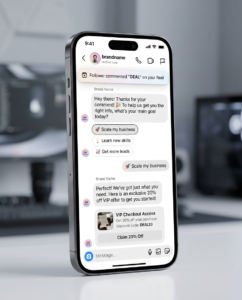
By contrast, a DM automation funnel powered by Meta’s official Instagram Graph API (using compliant tools like Manychat, CreatorFlow, or LinkDM) compresses that journey into two frictionless in-app steps: the user comments a specific trigger word (such as “DEAL” or “GUIDE”) on your post, and your automated workflow delivers the exact checkout or lead magnet link straight into their private inbox within three seconds. According to Manychat’s 2026 Conversion Rates by Marketing Channel report (citing CommuniPass and HypeAuditor studies across 6,000 creators), automated DM flows achieve conversion rates between 12% and 20%—outperforming one-off email campaigns (0.16%), automated email flows (2.1%), TikTok Ads (1.5%), and standalone landing pages (6.6%)—while generating up to 150% more comments per post.
Choosing the Right BOFU Conversion Mechanism: Decision Framework
Rather than relying on a single checkout path, high-performing brands match their bottom-of-funnel mechanism to the price point and complexity of the offer:
| Conversion Mechanism | Best Use Case & Offer Price Point | Step Count | Typical Conversion Benchmark | Material Limitation & Compliance Rule |
|---|---|---|---|---|
| Comment-to-DM Keyword Automation | Single-product promos, lead magnet email capture, coaching applications (£0–£500 / $0–$600) | 2 steps | 12%–20% DM-to-sale CVR; 30%–50% email capture rate | Must use official Meta Graph API (capped at 750 private comment replies/hour); only messages user-initiated commenters |
| Native In-App Checkout (TikTok Shop / IG Shop) | Impulse physical e-commerce products, bundles, and live shopping drops (£10–£80 / $15–$100) | 2–3 steps | 2.5%–6.2% in-app checkout CVR | Platform commission fees apply; limited custom upsell control compared to owned Shopify checkout |
| Link-in-Bio Multi-Link Storefront | Evergreen 15+ SKU catalogues, cross-platform traffic from YouTube/Pinterest | 5–6 steps | 2%–5% visitor opt-in; 1.4%–3.0% store CVR | High navigation drop-off on mobile; poor fit for time-sensitive single-product Reels |
When configuring lead magnet conversion inside DMs, always ask for the user’s email address inside the chat thread before delivering the free PDF, calculator, or discount code. Because Instagram and TikTok do not share follower email addresses with business accounts, capturing the email inside a two-tap DM conversation transfers your rented social audience into an owned Klaviyo or ConvertKit email list—where automated welcome flows convert at 2.1% and email-referred landing page visitors convert at 19.3%, per Manychat’s channel benchmark compilation.
Stage 5 (Retention): Turning Buyers into Repeat UGC Advocates
Post-purchase retention transforms first-time buyers into repeat customers and user-generated content advocates through automated onboarding messages, timed review requests, and community tagging incentives that feed fresh customer proof directly back into the top of your social funnel.
Acquiring a first-time customer through organic content or paid social ads is the most expensive part of your operation. If your funnel ends at the order confirmation screen, you are forced to rebuild momentum from zero every month. Instead, top-performing brands treat post-purchase retention as the engine of a continuous flywheel. According to Sprout Social’s Customer Loyalty KPI study, consumers who experience a positive post-purchase social interaction are 78% more likely to buy from the brand again, 76% more likely to recommend the brand to friends, and 72% willing to increase their overall spending.
Automating the Post-Purchase UGC Flywheel
To monetize social audience segments repeatedly and generate a self-sustaining stream of top-of-funnel creative, implement three retention triggers immediately after checkout:
- Send an automated 48-hour DM onboarding check-in: Connect your Shopify or CRM webhook to your DM automation platform so buyers receive a personal thank-you voice note or quick-start tutorial video 48 hours after ordering, reducing buyer’s remorse and support tickets.
- Trigger a timed “Unbox & Tag” incentive 7 days post-delivery: Invite customers to film a 10-second Story unboxing or share their 14-day transformation result tagging your handle in exchange for a 25% VIP reload voucher or entry into a monthly £200/$250 product bundle giveaway.
- Recycle tagged customer clips into Stage 1 and Stage 3 assets: Reshare tagged Stories into a permanent “Results” Highlight on your profile, ask permission to stitch customer reaction videos as new TOFU Reels, and screenshot verified buyer praise to populate your Stage 3 comment and carousel proof blocks.
Frequently Asked Questions
These frequently asked questions address the core mechanics, content ratios, conversion benchmarks, and social proof psychology behind profitable social media sales funnels, helping e-commerce brands, coaches, and creators diagnose revenue leaks and optimise every stage of their buyer journey.
1. How does a social media sales funnel work in 2026?
A 2026 social media sales funnel works as a multi-touch loop that attracts non-followers through searchable short-form videos, builds authority via educational carousels, validates legitimacy inside active comment threads, and closes transactions in-app using automated comment-to-DM checkout links.
2. Why do I have thousands of followers but zero sales?
Accounts with thousands of followers but zero sales usually suffer from an audience-offer mismatch caused by broad viral content, missing middle-of-funnel authority posts, barren comment sections that trigger buyer scepticism, and high-friction Link-in-Bio paths that lose mobile shoppers.
3. What is the ideal ratio of educational posts to sales posts (80/20 rule)?
The 80/20 rule allocates 80% of your social calendar to value-driven discovery and educational nurturing content, and 20% to direct promotional offers and comment-to-DM sales triggers, preventing audience ad fatigue while maintaining consistent weekly conversion opportunities.
4. How do comment-to-DM funnels outperform Link-in-Bio pages?
Comment-to-DM funnels outperform Link-in-Bio pages because they compress a six-step external browser navigation path into a two-step in-app conversation, delivering the exact checkout link into the prospect’s inbox immediately and boosting post visibility through comment velocity.
5. Why do customers check post comments before buying a product?
Customers inspect post comments before buying to verify human authenticity, real product quality, shipping reliability, and brand responsiveness, using peer discussions in the comment thread as a final safeguard against misleading advertisements, unresponsive merchants, and AI-generated storefronts.
Final Verdict
Building a profitable social media sales funnel requires replacing random posting and passive bio links with structured short-form discovery, authority-building carousels, visible comment-section social proof, and automated DM checkout flows that guide prospects seamlessly from first view to repeat purchase.
Before publishing your next week of content, audit your profile from the perspective of a sceptical first-time visitor: ensure your latest Reels hook a specific buyer problem, your carousels answer your top three pricing or product objections, your offer posts display active and credible comment conversations, and every call to action triggers an instant DM checkout sequence rather than making mobile buyers hunt through an external bio page. Need help scaling or have an editorial question? Reach out via the Social Mention UK Contact Page or explore more playbooks on Social Mention UK.

Discussion