


Quick summary: Real followers are active accounts that match your niche. To get them, post steadily, mostly Reels, keep a profile that explains who you help, and collaborate with accounts sharing your audience. Bought followers add a number, not engagement.
| Stage | What to do | Evidence strength |
|---|---|---|
| Discovery | Post 3–5 feed posts or Reels a week, and collaborate | Buffer posting-frequency data (all feed formats pooled) |
| Profile visit to follow | Clear name field, bio and three pinned posts | Practitioner guidance; no published benchmark |
| Search | Keywords in name, username and captions | Name and username are searchable; ranking weights unpublished |
| Retention | Broadcast Channels and Stories | Instagram’s own announcement; Buffer on Stories |
In this guide, “real” means accounts that are active, relevant and able to engage. Growth built on bots, follow-unfollow loops or rented engagement tends to be short-lived, because Instagram removes inauthentic activity. Automated tools generally break the platform’s rules, and Instagram’s Help Center warns about third-party apps that promise likes or followers. The methods below explain how to get real Instagram followers through growth you can measure and keep.
Publish Shareable Reels Built for Non-Follower Discovery
Reels are the format built for reaching people who don’t follow you yet, so they should carry most of your discovery effort. Buffer’s analysis of over two million posts found that 3–5 posts a week grew followers faster than 1–2.
Buffer analysed 2.1 million posts from 102,000 accounts and grouped weekly posting into buckets. Comparing each account only with its own baseline, weeks with 1–2 posts added 0.12 percentage points to follower growth compared with weeks without posts, while weeks with 3–5 posts added 0.26 points, more than double. On a 5,000-follower account, Buffer’s worked example puts the difference at about 13 extra followers a week.
Two caveats matter. Buffer pooled photos, carousels and Reels in the same analysis, so it does not show an ideal Reels-only schedule. It also measures association rather than proof that posting alone causes growth. Buffer’s data scientist suggests content quality probably remains the most important factor, and very high frequency brings diminishing returns and burnout. Treat the numbers as a reason to build a sustainable rhythm, not a reason to post ten times a week.
For each Reel, put the hook in the first two seconds, keep one clear topic and open the caption with the problem in plain words. If your reach has already fallen, why your Instagram reach is dropping and how to fix it covers the likely causes before you change your schedule.
Optimise Your Bio and 3 Pinned Posts to Turn Visitors into Followers
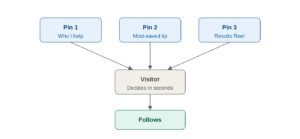
Profile visitors decide whether to follow within seconds, based on your name, bio and first posts. Set a name stating your niche, write a bio saying who you help, and pin three posts: a welcome post, a useful tutorial and a results Reel.
Your name field is the bold line under your profile picture, and it is searchable, so it does two jobs at once. Something like “Jordan Lee | Budget Travel UK” tells a visitor and the search system what you offer, and it stays within Instagram’s 30-character limit. Keep your username and bio consistent with it so the story is the same wherever someone looks.
Pinned posts sit at the top of your grid, where visitors look first, so they carry most of the conversion work. The first should explain who you help and what they gain from following. The second should be your most-saved value carousel, showing what following delivers. The third should be social proof, such as a short results Reel or a client comment you have permission to share.
Measure the change rather than assuming it worked. Record profile visits and follower changes for four weeks before and four weeks after you update the profile, then compare the two periods. Your own baseline is more useful than any published benchmark, because it reflects your audience and your niche.
Use Instagram Collab Posts to Tap Into Partner Audiences
An Instagram collab post appears on up to six accounts’ grids, so it reaches each collaborator’s followers as well as yours. Choose partners whose audience matches yours, confirm both accounts accept the invite, and measure results on your own profile.
Collabs work on feed posts and Reels, not Stories. You can add up to five collaborators to one post, and each invited account must accept before the post appears on its grid. Likes and comments are shared across the post, so engagement from every audience counts toward one piece of content.
Partner choice matters more than the feature itself. A collaborator with a bigger following but a different audience may bring attention without follows. Look at whether their comments show real discussion, and whether their followers would plausibly want what you offer. Many creators keep a collab to one or two partners, which keeps the caption focused.
Buffer’s posting research does not break out collab posts, so the evidence for collabs comes from how the feature works and from your own data. Compare reach and new followers on collab posts with your usual posts for at least a month before deciding how often to repeat the format.
Rank in Instagram Search with Keyword-Optimised Names and Captions
Instagram search matches typed terms against your name, username, bio and captions. Put the words your audience searches for in your name field and opening caption line, keep them natural, and note that Instagram does not publish how much weight each field carries.
Start with what people actually type. Think about the job you do and the place you serve, then write it the way a customer would. A London fitness coach, for example, might be found through a phrase such as “postnatal fitness London”, so that phrase belongs in the name field, the bio and captions where it fits.
Keep captions readable. Repeating one keyword several times reads as spam. Use one or two relevant terms in the first line, then write the rest for people who have already decided to read. Hashtags can still help people find posts, but they work best as a supporting signal alongside your profile keywords.
Turn Top Comments on Big Niche Accounts into Profile Visits
Thoughtful comments on posts from larger niche accounts can put your name in front of an audience that already cares about your topic. Comment early, add something specific, and keep your profile ready, since visitors judge it quickly.
Pick five to ten accounts whose comment sections are active and whose audience overlaps with yours. Comment within the first hour of a post, when your reply is more likely to be seen. A comment that answers a question or adds a practical detail earns more attention than a generic compliment.
Do not use comment bots or automation for this. Instagram’s Help Center notes that non-Instagram apps which create automated likes, comments and follows make an account appear more popular than it is, and that this inauthentic activity goes against its rules. Manual replies take longer, but they are the only version that builds relationships you can keep.
Keep a simple log of which accounts you commented on and whether profile visits rose on those days. It will not be exact, but it shows which partners are worth your time.
Establish Baseline Social Proof to Boost Organic Follow Rates
Visitors often judge credibility by follower count, so some baseline numbers can make a profile feel more trustworthy. Paid followers can supply that baseline, but they add little engagement and can put your account at risk, so treat them as a small supplement.
The trade-off is straightforward. Purchased followers often come from inactive or fake accounts, so they rarely like, comment, save or share your posts. That lowers your engagement rate, which visitors and the platform both use as a signal of whether a profile is worth following. Instagram’s Help Center warns that if you use one of these apps to gain likes or followers, your account may be disabled or terminated, and provider quality varies widely.
Illustrative example, not a client result. A personal branding coach receives 3,000 profile visits a month from Reels but gains only 120 followers, a 4% conversion. The account shows just 650 followers, which makes visitors hesitate. After setting up the three-pinned-post structure and buying 2,000 followers as a starting baseline, the conversion rate rises to 18.5%, which on 3,000 visits is roughly 555 new followers a month. The example shows how a credible profile can change conversion. It is not a guaranteed result, and purchased followers do not replace engagement.
If you are considering a paid option, read the provider’s terms first. Check its refill and retention policy, ask how followers are delivered and be wary of “guaranteed” claims with no figure attached. Build organic momentum first, then treat any purchase as a modest supplement. The two links here go to a commercial provider: order Instagram followers on SoldOutX or pair follower growth with consistent post likes.
Keep New Followers Engaged with Broadcast Channels and Stories
Acquisition only pays off if new followers stay. Broadcast Channels give you a direct, one-to-many line to people who choose to join. Instagram explains that after your first message, all followers receive an invitation to join, but only followers who join receive later updates, which makes the channel suited to behind-the-scenes posts, polls and new-content alerts.
Stories are a retention tool more than a discovery one. Buffer notes that Stories are typically not shown to non-followers, so they work best for keeping current followers engaged through polls, questions and links. Where your account has access, share your Broadcast Channel link in Stories and your bio so new followers know where to find it.
Frequently Asked Questions
These questions cover what readers ask most often about growing followers without buying engagement. The answers draw on Buffer’s posting research and the steps covered above, and each one stands alone when read on its own.
What is the fastest way to get real followers on Instagram in 2026?
The fastest reliable route is consistent posting of 3–5 feed posts or Reels a week, plus collaborations and a clear profile. Buffer’s data links that rhythm to faster follower growth than posting once or twice a week, though results vary by account.
What should you pin to the top of your Instagram grid to get more followers?
Pin three posts: a welcome post explaining who you help, your most-saved value carousel, and a short proof-of-results Reel or permitted client comment. Together they answer the questions most visitors have before they decide to follow.
How do Instagram Collab posts help you gain followers?
A collab post appears on up to six accounts’ grids, so it reaches each collaborator’s audience. Likes and comments are shared across the post. Results depend on audience fit, so measure new followers after each collab before repeating it.
What is a good profile-visit-to-follower conversion rate?
Reliable published benchmarks for this metric are hard to find, so your own figure matters most. Divide new followers by profile visits each month, then compare the result before and after you update your name field, bio and pinned posts.
Does having higher initial follower numbers increase organic follow-backs?
Possibly, because visitors often read follower count as a credibility signal. However, few reliable public studies measure this directly, and a clear reason to follow matters more. Purchased accounts rarely engage, so they are unlikely to lift follow-backs.
Final Verdict
The most dependable way to get more real Instagram followers is consistent Reels, a profile that is clear within seconds and collaborations with accounts sharing your audience. Paid followers add a visible number but not the engagement that keeps an audience.
Start with a month of steady posting and profile fixes, since these cost time rather than money and their effect shows up in your own Insights. Add a collab once your profile is ready, because partner visitors will judge the same page. Use any paid option only as a small supplement, and keep your attention on the measure that matters most: how many people who see your content choose to follow and stay.
