

Quick answer
Viral reach depends on three things: a hook that stops the scroll within three seconds, pacing that holds attention through a seamless loop, and early engagement that earns a wider test audience. Neither platform publishes an exact formula, so treat these benchmarks as working targets.
Use this scorecard to judge each post against those working targets.
| Metric | What it measures | Working target |
|---|---|---|
| 3-second hold rate | Share of plays still watching at the 3-second mark | 65% or higher |
| Average watch time | Average viewing time as a share of video length | 100% or higher |
| Share rate | Shares divided by reach | 3% or higher |
| First-hour engagement | Likes and shares in the first hour | Above your own recent average |
Step 1: Understand the Viral Metric Thresholds
Viral distribution responds to how viewers behave, not how many followers you have. Three numbers capture most of that behaviour. The 3-second hold rate is the share of viewers still watching at the three-second mark, and it shows whether your opening earns the next few seconds. Average watch time compares how long people actually watch with the video’s length. A figure above 100% means some viewers replayed it, which is what a strong loop produces. The share rate compares shares with reach and shows whether people found the content worth passing on.
These targets are working benchmarks for judging posts. Instagram and TikTok do not publish them. Dashboards also report retention differently, and some show views at two and six seconds, so you may need to estimate the three-second mark from a retention graph. Your own baseline is more reliable than any universal number, so compare each post with your last ten. For a fuller view of the dashboards to check, read our guide to top social media metrics brands must track.
Step 2: Script a Triple-Layer Hook (Visual, Audio, On-Screen Text)
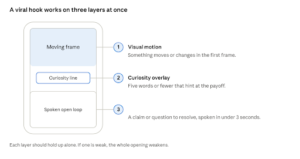
A strong opening works on three layers at once. The visual layer is motion or an unusual frame that catches the eye immediately. The audio layer is the first spoken sentence, which should open a loop: a claim or question the viewer wants resolved. The on-screen text is a short curiosity line that hints at the payoff without giving it away. Each layer does a different job, so one weak layer can drag down the whole opening.
Write the spoken line first, because it carries the most meaning and the other layers should support it. Keep it under three seconds, and drop greetings, channel introductions and slow setups. Next, choose a visual that shows something happening rather than a static talking head, and write an overlay of five words or fewer. Then test each layer alone. If the audio would not stop a scroll on its own, rewrite it before adding anything else.
Triple-layer hook anatomy: three layers, one opening
A hook also carries a risk. If it promises more than the clip delivers, viewers feel misled and leave, which drags down average watch time. The opening should set up a payoff that the video actually provides.
Step 3: Edit with Pattern Interrupts Every 2–3 Seconds and Seamless Loops
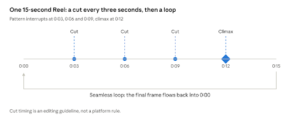
A pattern interrupt is any change that resets attention: a cut, a zoom, a shift in camera angle, a sound effect or a new line of text. Many short-form editors place one every two to three seconds. That is an editing guideline, not a platform rule, and it has limits. Fast cutting suits visual content, but on a slower explanation it can feel frantic and make the point harder to follow, so use the rhythm where it helps comprehension.
For a 15-second Reel, a practical timeline places the first interrupt at 0:03, the second at 0:06 and the third at 0:09, then builds to a climax at 0:12. The final frame should flow back into the opening. That is the seamless loop. The last action or sentence should lead naturally into the first frame, so the replay feels continuous rather than like a jump back to the start.
15-second Reel timeline: cuts at 3, 6 and 9 seconds, climax at 12, loop to 0
Loops suit short clips with a clear beginning and end. Longer explainers need a different close, such as a summary or a clear next step.
Step 4: Anchor Your Topic to Broad-Appeal Cultural or Niche Pain Points
Posts that travel usually attach to something the audience already feels: a shared frustration, a recognisable moment or a trend people already follow. Broad cultural references reach more people, but they fade quickly and often attract viewers who will never buy from you. Niche pain points travel more slowly, yet the viewers they reach are more likely to follow and act.
To choose a topic, collect three problems your audience raises in comments, direct messages and search queries. Pick the one that comes up most often, then add a detail that only someone in your niche would recognise. Joining a trend you do not understand usually backfires, so only use a trend when the connection to your subject is genuine. Avoid topics that trade on someone else’s tragedy, whatever the reach.
Step 5: Engineer a Comment-Sparking Open Question or Debate
Comments are a strong sign that a post has prompted a conversation, and an active thread can keep it circulating. The most effective prompts ask something people genuinely disagree on, such as whether posting daily is worth it when the videos are weaker. Pick a question people can answer from their own experience, and state your own view briefly so the thread has something to respond to.
Avoid engagement bait. Meta’s rules discourage posts that explicitly demand likes, comments or shares, and “comment YES if you agree” posts risk reduced reach and a weaker reputation with viewers. Reply to the first few comments within the hour. That keeps the thread active and shows the conversation is real.
Step 6: Seed First-Hour Velocity to Pass the Algorithm Test Batch
Early engagement matters because platforms commonly test new content with a small audience before deciding whether to show it more widely. Neither Instagram nor TikTok has documented this process step by step, but it is a widely described pattern, and it explains why the first hour counts. The most reliable way to seed that group is with people who want to see your work: existing followers, close contacts and communities you already belong to. Ask them to watch and comment within the first hour, and publish only when the clip is finished, because a weak start leaves nothing to build on.
Some creators also buy early likes or shares, so be clear about the trade-off. Instagram began removing likes and follows bought from third-party apps in 2018, as AdvertiseMint and Tubefilter both reported at the time. Its Community Guidelines discourage artificially collecting likes, followers or shares, so accounts that rely on purchased engagement risk penalties. Bought engagement also does not bring viewers who stay: Sprout Social notes that purchased likes do not produce real clicks or conversions. If you test a paid option such as catalyze first-hour like velocity with SoldOutX, treat it as a short experiment, judge it by retention and comments rather than the like count, and never let it replace a clip that holds attention. The same caution applies to buy Instagram reposts to trigger viral waves.
Worked example (illustrative figures, not a real account)
Imagine a 14-second clip that reaches 10,000 plays. If 6,800 viewers are still watching at the three-second mark, the hold rate is 68%, above the 65% benchmark. Suppose the same clip reaches 12,000 accounts and gets 330 shares. That gives a share rate of 2.75%, just below the 3% target, which points to a stronger closing call to action rather than a new hook. An average watch time of 15 seconds on a 14-second clip works out at 107%, which means a meaningful share of viewers replayed the loop.
Step 7: Double Down with Follow-Up Replies and Part-2 Series
The first wave of a post fades within days, but the demand it created does not have to. A follow-up can capture it. Make a part two that answers the question you left open, or post a reply or stitch that points back to the original. Link the two in the captions, and pin the stronger post to your profile so new visitors see it first.
A sequel only works when the original held attention. If the first clip lost viewers early, a part two will not rescue it. Plan a short series of three parts before posting part one. That tells the audience what to expect and lets you judge each part against the same benchmarks.
Frequently Asked Questions
How many views is considered viral on social media in 2026?
There is no official threshold. A post is viral when its reach is several times your recent average, especially among non-followers. Compare each post against your last ten to judge this, since absolute view counts mean little across different account sizes.
Can a brand-new account with 0 followers go viral?
Yes, it is possible, because short-form feeds can show your video to people who do not follow you. A new account has less history and a smaller starting audience, so tight hooks and consistent posting matter even more.
What watch-time percentage is needed to go viral on Reels and TikTok?
No platform sets a fixed percentage. As a working benchmark, aim for a 65% or higher three-second hold rate and an average watch time above 100% of video length. These are self-assessment targets, not published rules.
Why do some viral videos bring zero new followers?
Reach and loyalty differ. Viewers often enjoy a one-off clip but have no reason to follow, because the profile offers no clear series or repeatable value. Make the next video’s promise obvious and keep one recognisable format.
How do initial likes and reposts help push a post onto Explore?
Early engagement is one signal a platform can use when deciding whether to test a post with a wider audience. Strong early numbers can help, but they do not guarantee distribution, and the post still has to hold attention.
Final Verdict
Going viral is partly luck, and no process removes that. This seven-step approach raises the odds that the right viewers see your post and keep watching. Start by measuring your last ten posts against the scorecard above. Then change one element at a time, whether the hook, the pacing or the closing, and keep the changes that improve your hold rate and average watch time. Over time those gains add up, and a post that performs well becomes a source of repeatable lessons rather than a one-off win.

Discussion