

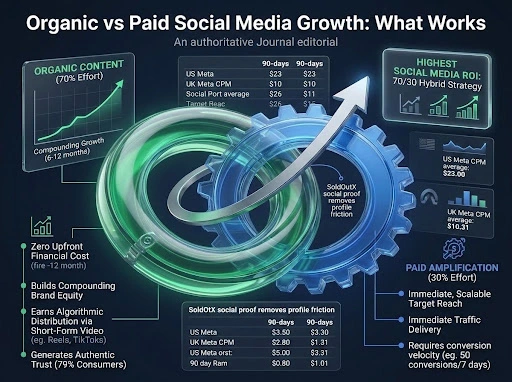
Deciding between organic vs paid social media in 2026 is no longer an either-or choice because neither channel delivers maximum return on investment (ROI) in isolation. Pure organic content builds high-trust communities at zero media cost but takes six to twelve months to compound, whereas pure paid advertising buys immediate targeted traffic that stops the moment your budget pauses. For UK and US brand managers, founders, and creators, the highest-performing model is a 70/30 hybrid social strategy that combines high-retention organic Reels with foundational social proof and selective paid amplification.
Quick Summary: Organic vs Paid vs Hybrid Social Growth
Organic social media builds compounding audience trust at zero media cost over six to twelve months, whereas paid advertising buys immediate targeted reach that stops once budgets pause; combining 70% organic content with 30% targeted promotion delivers the highest 2026 ROI.
| Comparison Criteria | Organic Content (Reels, TikToks, Carousels) | Paid PPC Ads (Meta & TikTok Ads) | SoldOutX Engagement Growth |
|---|---|---|---|
| Upfront Financial Cost | £0 / $0 media spend; requires consistent creative production time | High and rising: UK Meta CPM averages $10.31; US Meta CPM averages $23.00 | Low, fixed entry cost starting from $5 with zero auction inflation |
| Speed to Traction | Slow linear ramp requiring 6 to 12 months for compounding reach | Immediate traffic delivery after clearing the 7-day / 50-conversion learning phase | Instant to 24-hour delivery to establish baseline profile credibility |
| Audience Retention | High organic retention; evergreen videos earn algorithmic discovery for weeks | Zero residual reach; impressions and clicks halt immediately when spend stops | Lasting visual social proof across pinned posts and profile counters |
| Primary Funnel Role | Validates creative hooks, nurtures community loyalty, and drives social SEO | Scales proven offers to cold demographic, interest, and lookalike audiences | Eliminates cold-profile bounce rates and strengthens early engagement velocity |
| Typical ROI Profile | Compounding long-term brand equity and lowest long-run customer acquisition cost | Direct short-term conversions (1.86 median Meta ROAS across DTC verticals) | High multiplier effect: lowers paid CPC and lifts post-click conversion trust |
1. The State of Organic Social Media in 2026: Pros & Cons
Organic social media in 2026 offers zero-ad-spend credibility and high-retention community building, whereas paid campaigns guarantee immediate impressions; however, with average organic feed reach sitting near 1.25% to 3.5%, brands must prioritise short-form video over static posts to earn algorithmic distribution.
Evaluating organic reach vs paid ads starts with understanding how drastically unpaid distribution has contracted on legacy feeds. According to the Hootsuite Organic vs Paid Social Media Report, algorithms now prioritise paid placements and high-interaction threads, leaving traditional brand feeds with a fraction of their historical visibility. Average Facebook organic reach dropped from 16% of followers in 2012 to between 1% and 2% entering 2026, with large pages above 100,000 followers reaching just 0.50% of their audience per post. Instagram overall reach fell 12% year-over-year to a 3.50% average reach rate, while LinkedIn company pages experienced a 34% year-over-year contraction.
Yet organic social remains indispensable because discovery now depends on content format rather than follower count. While a static Instagram photo reaches roughly 0.5% of an audience, Instagram Reels achieve approximately 9% organic reach—an 18-times distribution multiplier on the exact same account. Similarly, TikTok business accounts reach roughly 5.7% of their audience organically and generate a 2.01% median engagement rate, outperforming Instagram’s 0.30% median follower engagement rate. Furthermore, 79% of consumers trust user-generated and authentic organic content when making purchasing decisions, compared with just 13% for branded ads.
The primary limitation of pure organic growth is the cost vs time tradeoff. Even when publishing at optimal 2026 cadences—three to five Instagram posts weekly and one to two daily updates on Facebook, LinkedIn, or TikTok—building self-sustaining organic momentum takes six to twelve months of consistent production. For time-sensitive product launches or quarterly revenue targets, relying solely on unpaid algorithms is too slow.
2. Paid Social Advertising: High Speed, Rising Costs
Paid social advertising delivers immediate, demographic-targeted reach and scalable traffic within hours, whereas organic growth requires months of compounding effort; however, rising 2026 auction costs—averaging $10.31 CPM in the UK and $23.00 in the US—make unassisted paid acquisition increasingly expensive.
When speed and targeting precision matter, social media paid promotion across Meta Ads and TikTok Ads delivers immediate scale. Global social ad expenditure is forecast to grow 15.6% in 2026, with US spending exceeding $121 billion. That influx of capital has intensified auction competition across every vertical. Full-year tracking across 35,000 ad accounts shows that Meta CPMs jumped 20.03% year-over-year across all 15 industries to a $14.19 platform median, pushing median customer acquisition cost (CPA) to $38.19 and holding median return on ad spend (ROAS) to 1.86. In Tier 1 markets, UK Meta campaigns average $10.31 CPM ($1.95 CPC) and US campaigns average $23.00 CPM ($2.69 CPC), with Q4 holiday auctions surging by more than 60%. On TikTok, 2026 auction CPM benchmarks span $4.00 to $13.00 ($0.30–$1.50 CPC), with e-commerce conversion campaigns averaging $13.26 CPM and a $32.74 median CPA.
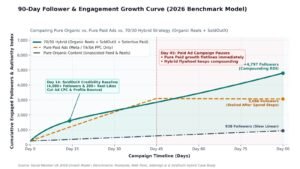
| Timeline Milestone | Pure Organic Content (Linear) | Pure Paid PPC Ads (Stops at Day 45) | 70/30 Hybrid Strategy (Organic Reels + Social Proof) |
|---|---|---|---|
| Day 0 (Baseline) | █░░░░░░░░░ 250 followers | █░░░░░░░░░ 250 followers | █░░░░░░░░░ 250 followers |
| Day 15 (Credibility Phase) | ██░░░░░░░░ 380 followers | ████░░░░░░ 1,220 followers | █████░░░░░ 2,680 followers (4k+ target base initiated) |
| Day 30 (Momentum Phase) | ██░░░░░░░░ 510 followers | ██████░░░░ 2,110 followers | ███████░░░ 3,540 followers (Reels hitting ~9% reach) |
| Day 45 (Ad Spend Pauses) | ███░░░░░░░ 650 followers | ███████░░░ 3,100 followers (Peak) | ████████░░ 4,580 followers (Overtakes pure paid) |
| Day 60 (Post-Campaign) | ███░░░░░░░ 810 followers | ███████░░░ 3,080 followers (Flatlined) | █████████░ 5,450 followers (Compounding flywheel) |
| Day 90 (Quarter End) | ████░░░░░░ 1,060 followers | ███████░░░ 3,065 followers (Stalled) | ██████████ 6,690+ followers (Highest 90-Day ROI) |
Pure paid campaigns also face strict learning-phase math and rapid creative fatigue. Exiting TikTok’s algorithmic learning phase requires roughly 50 conversions within seven days—meaning a brand with a $25 target CPA needs about $250 daily ($1,250 weekly) per ad group rather than the platform’s $20 daily minimum. Meanwhile, because users scroll social feeds for more than 18.5 hours weekly, overt ads suffer rapid banner blindness; as click-through rates (CTR) dip over consecutive days, auction algorithms penalise relevance and drive effective CPCs sharply higher.
3. Why Paid Ads Fail on Low-Credibility Profiles
Paid ads generate top-of-funnel clicks regardless of follower size, whereas organic profiles supply the visible social proof required to convert that traffic; when prospective buyers click an ad and find an empty profile, bounce rates and customer acquisition costs rise sharply.
The biggest budget leak in paid social is the post-click credibility gap. While stronger video hooks lifted median Meta CTR by 13.5% year-over-year to 2.19%, the median post-click conversion rate sits at just 1.60% (and drops to 1.20% in high-consideration verticals like Electronics). In categories such as Travel Accessories & Luggage, CTR climbed 17.09% while conversion rates fell 16.72%, proving that generating ad clicks without profile trust burns budget.
Before buying from an unfamiliar UK or US brand, cold shoppers routinely tap the advertiser’s Instagram or TikTok handle to verify legitimacy. If a polished video ad leads to a profile with 250 followers, three likes on pinned posts, and zero comments, buyers suspect an untested dropshipper and abandon the funnel. That makes building social proof fast on any platform an essential pre-launch step before scaling ad spend. Establishing a credible baseline of followers, likes, and views via SoldOutX alongside active organic Reels removes that friction, while native ad formats like TikTok Spark Ads—which attribute all paid views, likes, comments, shares, and follows directly back to the original organic post—compound visible social proof on every impression.
4. The Hybrid Growth Framework: Combining Organic Content with SoldOutX
A hybrid growth framework pairs high-retention organic Reels with targeted social proof and paid amplification, outperforming standalone strategies by lowering ad click costs while accelerating algorithmic discovery across Instagram and TikTok without relying exclusively on expensive auction impressions.
Modern marketing teams manage organic and paid channels as one integrated system: 75% of marketing leaders now prioritise combined paid and organic social, with 65% tying campaigns directly to revenue and 52% targeting measurable cost savings. Integrating SoldOutX targeted growth packages between your organic content calendar and your paid ad manager creates a repeatable hybrid social strategy flywheel that lowers blended acquisition costs.
Mini Case Study: UK Coffee Brand Cutting Ad CPA by 38%
- Before (Pure Paid Ads): A UK e-commerce coffee brand was spending £1,200/month on Meta Ads but facing a steep £2.40 cost-per-click (CPC) and weak checkout conversion because their Instagram page had only 290 followers and sparse interaction, causing cold ad clickers to bounce during profile checks.
- The Hybrid Shift: Rather than raising ad spend, the brand shifted £200 of its monthly budget into SoldOutX growth packages to build a 4,000-follower base and 200+ likes on top organic Reels, keeping £1,000 on Meta ads.
- After (90-Day Result): Visible social proof validated the profile for incoming traffic; ad click-through rate (CTR) doubled and overall cost-per-acquisition (CPA) dropped by 38%.
Step-by-Step Hybrid Flywheel Execution
- Validate Creative Organically First: Publish three to five vertical videos (Instagram Reels and TikToks) weekly to test opening hooks, educational angles, and lo-fi product demos at zero media cost. For example, PureGym earned a 5.6-times lift in ThruPlays simply by replacing polished studio ads with lo-fi handheld Reels that matched native feed styles.
- Reinforce Early Velocity with Social Proof: When an organic Reel shows strong early watch time—or when pinning three hero posts to the top of your profile grid—use targeted engagement packages to add followers, likes, views, saves, and shares with no password required. Because platform algorithms weight saves, shares, and early engagement velocity heavily for Explore and For You Page distribution, social proof amplification supports both algorithmic reach and human buyer trust.
- Scale Only Proven Winners with Paid Spend: Review retention analytics after 48 to 72 hours and put Meta or TikTok ad spend strictly behind the top 10%–20% of organic posts that already convert viewers. Brands like Good Protein have lifted watch time by 25% by combining creator Spark Ads with organic video replies, while NARS Cosmetics cut cost per purchase by 24% by pairing proven social creative with native Instagram Shop checkout.
To keep your hybrid strategy sustainable, account for material limitations: social proof cannot rescue weak three-second video hooks or slow landing pages, and seed audiences for Meta or TikTok lookalike campaigns should always be built from verified website purchase pixels or 50%+ video view segments rather than broad follower lists.
5. How to Allocate Your Growth Budget by Account Stage (0–1k, 1k–10k, 10k+)
Allocating growth budgets by account stage prevents wasted ad spend: sub-1,000-follower profiles benefit most from a 70/30 split favouring organic creation and foundational social proof, whereas accounts exceeding 10,000 followers can profitably scale paid conversion and retargeting auctions.
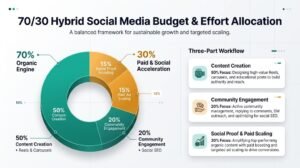
| 70/30 Hybrid Pillar | Share of Budget & Effort | Visual Allocation Bar | Core Execution Channels & ROI Role |
|---|---|---|---|
| 1. Short-Form Organic Creation | 50% (Organic Engine) | ██████████░░░░░░░░░░ 50% | Publish 3–5 Instagram Reels, TikToks & carousels/week (~9% organic reach vs 0.5% static photos) to test hooks at £0/$0 media cost. |
| 2. Community & Social SEO | 20% (Organic Engine) | ████░░░░░░░░░░░░░░░░ 20% | Optimise captions/audio for search discovery, reply to comments/DMs, and engage on niche creator posts (used by 41% of brands). |
| 3. Social Proof Boosting | 15% (Acceleration) | ███░░░░░░░░░░░░░░░░░ 15% | Establish 1,000–4,000+ follower baseline and 200+ likes/saves on pinned hero Reels to eliminate cold-profile bounce rates. |
| 4. Paid Ad Scaling (Meta & TikTok) | 15% (Acceleration) | ███░░░░░░░░░░░░░░░░░ 15% | Boost only top 10%–20% validated organic winners via Spark Ads and retargeting after a 48–72h retention check (cuts CPA by up to 38%). |
Practical rules for balancing organic and paid social evolve across three distinct account stages:
- Stage 1: Cold Start (0–1k Followers) — 70% Organic | 20% Social Proof | 10% Micro-Boosts: Avoid expensive cold conversion ads while your profile sits below 1,000 followers. Dedicate 70% of effort to posting three to five Reels weekly, optimising social SEO captions, and leaving thoughtful comments on niche creator posts—a proactive tactic used by 41% of brands to earn early visibility. Allocate 20% of your budget to building a 1,000–2,500 follower baseline and 100+ likes on your three pinned posts, and use 10% ($5–$10/day) to boost only your highest-retention Reel for profile visits.
- Stage 2: Momentum (1k–10k Followers) — 70% Organic | 15% Post Social Proof | 15% Spark & Retargeting Ads: Smaller business pages enjoy the highest relative organic reach percentages on social platforms—averaging 4.35% on Facebook and roughly 9% on Instagram Reels. Pair consistent Reels and high-engagement carousels with 15% budget on saves, shares, and likes for breakout videos, plus 15% ($20–$50/day) on TikTok Spark Ads and Meta retargeting for website visitors and warm video viewers.
- Stage 3: Scale (10k+ Followers) — 65%–70% Organic | 5%–10% Social Proof Maintenance | 20%–30% Conversion Auctions: With 10,000+ followers anchoring post-click credibility, your profile can absorb cold paid traffic without high bounce rates. Fund structured conversion campaigns in Meta Advantage+ and TikTok Smart+ using the 10× target CPA daily budget rule to clear the 50-conversion learning threshold, promoting only creative angles already validated on your organic feed.
Frequently Asked Questions
Comparing organic content, paid social advertising, and targeted engagement services requires evaluating cost per result, timeline to traction, and profile credibility; these five answers summarise how UK and US brands balance each channel for sustainable return on investment in 2026.
1. Is organic social media dead in 2026?
No, organic social media is not dead in 2026, but static feed reach has fallen to roughly 0.5% to 1.25% of followers. Brands that shift to short-form video like Instagram Reels and TikTok still achieve 5.7% to 9% organic reach.
2. What is the best budget split between organic content and paid growth?
The optimal framework for creators and small businesses is the 70/30 hybrid split: allocate 70% of time and resources to high-retention organic content and community management, and invest 30% into targeted social proof amplification and paid promotion on proven posts.
3. Why do paid social ads perform poorly on brand-new accounts?
Paid social ads underperform on brand-new accounts because cold prospects routinely inspect a brand’s profile before purchasing. When visitors encounter fewer than 500 followers and zero comments, scepticism spikes, causing high post-click bounce rates and inflated customer acquisition costs.
4. How do engagement growth packages differ from Meta or TikTok ads?
Meta and TikTok ads auction temporary impressions and clicks to targeted demographics, stopping the moment your budget ends. Engagement growth packages strengthen on-page credibility—such as follower counts, likes, and saves—which improves profile trust and helps organic posts trigger algorithmic reach.
5. Can a small business grow using a hybrid social strategy?
Yes, small businesses often gain the highest return from a hybrid social strategy because they cannot afford wasted ad spend. Validating hooks organically first, reinforcing top posts with baseline engagement, and boosting only proven winners keeps customer acquisition costs sustainable.
Final Verdict
Pure organic growth builds lasting authority too slowly for competitive launches, while pure paid advertising suffers from rising CPMs and low-trust bounce rates; a 70/30 hybrid strategy uniting native video, baseline social proof, and selective paid scaling wins in 2026.
To maximise your social media ROI over the next 90 days, audit your organic short-form videos to identify your highest-retention hooks, reinforce your profile’s foundational credibility and hero posts with targeted social proof, and reserve your Meta and TikTok ad budgets strictly for scaling proven organic winners.
