


Quick Summary
Social proof is the visible evidence that other people already trust you: followers, likes, comments, reviews and customer content. To build it fast, make your profile look credible within seconds by leading with real customer evidence and adding growth support transparently.
| Pillar | What visitors should see | Fast check |
|---|---|---|
| 1. Header and pinned posts | A clear bio and three posts that prove your value | Can a stranger say what you offer after one glance? |
| 2. Baseline followers | A follower count that fits your niche and stage | Does the count match your engagement? |
| 3. Post engagement | Likes and specific comments on key posts | Are the comments recent and specific? |
| 4. UGC and testimonials | Customer photos, reviews, creator shoutouts | Is each item real and used with permission? |
| 5. Milestones and Highlights | Verifiable numbers and review Highlights | Can you back up every figure? |
The Psychology of Social Proof: Why Empty Profiles Kill Conversions
Visitors judge an unfamiliar account in seconds, and low numbers read as a warning. Social proof works because people use others’ behaviour as a shortcut for quality, so an empty profile suggests nobody has tried you, however good the product is.
Sprout Social’s guide to the concept explains that people trust other people more than they trust brands, and that a large, engaged following works as social proof in itself. Read more in Sprout Social’s guide to social proof. This is the logic behind “empty restaurant syndrome”: most diners walk past a dining room with no one in it, and a profile with 80 followers and no comments triggers the same hesitation.
The evidence on follower counts is more nuanced than most growth advice admits. A 2018 master’s study from NOVA School of Business and Economics, using a simulated Instagram feed, found that a large follower count raised purchase intention and brand trust, though it was small and used Portuguese-speaking participants. A more recent Conjointly survey of 307 US consumers found that trust in creators does not rise neatly with follower count, and scores rarely passed 40%. Numbers open the door. Substance, meaning proof a visitor can check, decides whether they walk through it.
Step 1: Optimise Your Profile Header and 3 Pinned Posts for Instant Trust
Start with the three things every visitor sees before scrolling: your bio, your highlights and your pinned posts. Make the bio state who you help and the result, then pin three posts showing proof, such as a customer result, a best-performing post and an offer.
Give each pin a different job. The first shows a real customer outcome, the second shows your product or service in use, and the third explains the offer and how to start. In the bio, add one proof point you can substantiate, such as a customer count, a recognisable client or a press mention, and link to a single clear destination. Instagram lets you pin up to three posts to the top of your grid, so use every slot.
A low-trust profile next to a high-social-proof profile. Illustrative mock-up with example figures.
Review the result as a stranger would, on a phone, without scrolling. If you cannot tell what you sell and why anyone should believe you, rework the pins before spending anything on growth.
Step 2: Overcome the Cold-Start Barrier with Baseline Follower Numbers
The cold-start problem is that nobody follows an account nobody follows. Break it by seeding a believable baseline: invite existing customers, partners and email subscribers first, then consider a paid growth service, understanding that purchased followers rarely engage and can breach platform rules.
Start with the free routes, because they bring real people. Put your handle in email footers and on packaging, share it with your newsletter list, and ask partners or suppliers to tag you. A few hundred genuine followers from your existing audience is a stronger base than a bigger number from nowhere. If you decide to speed things up, you could accelerate baseline follower authority with SoldOutX, but go in with open eyes. Purchased followers are unlikely to comment or buy. Instagram has said that third-party services generating inauthentic likes, follows and comments violate its Community Guidelines, and it removes that activity. In the US, the FTC’s 2024 rule bans buying fake social media indicators, such as followers generated by bots or hijacked accounts, where the buyer knew or should have known they were fake and used them to misrepresent their influence for a commercial purpose (FTC announcement). Never hand over your account password, and test any provider with a small order first.
| Illustrative scenario (hypothetical figures, not a measured result)
Imagine a US SaaS startup launching an Instagram page with 110 followers. Paid ad traffic lands on the profile, and 3% of visitors follow. The team adds three customer testimonial Story Highlights, pins three strong posts and builds its baseline to roughly 2,500 followers. If profile-to-follow conversion then rose to 19.5% on the same ad spend, every 1,000 profile visits would produce 195 follows instead of 30. Treat this as arithmetic, not a promise. Run your own before-and-after test and change one variable at a time, so you know which layer did the work. |
Whatever baseline you build, keep growth steady. A page that jumps from 110 to 2,500 followers overnight with no engagement looks odd to visitors and may attract platform attention, so let your engagement catch up in the following weeks.
Step 3: Strengthen Post-Level Credibility with Consistent Likes and Comments
Post-level credibility comes from visible, relevant engagement on the posts a visitor is most likely to open first. Aim for steady likes and real comments on pinned and recent posts, because specific comments look more convincing than a bare like count.
Watch the ratio between followers and engagement. A simple engagement rate is likes plus comments divided by followers, multiplied by 100. An account with 5,000 followers and eight likes per post sends a mismatch signal that visitors notice, which is why buying followers alone often backfires. The goal is balance. If you want to boost visible post likes on SoldOutX, apply them only to posts that already deserve attention, such as your pinned proof posts, and pair them with real discussion. Our guide to the best social media growth tools for small brands compares other ways to support engagement.
Build real comments in the ordinary ways. End posts with a question that has a concrete answer, reply to every comment within a day, and respond to comments with a sentence rather than an emoji so the thread reads as a conversation. Never buy or write fake comments or testimonials. Under the FTC rule, that is the clearest breach of all.
Step 4: Leverage User-Generated Content (UGC) and Micro-Endorsements
User-generated content works because it is proof written by someone other than you. Collect reviews, customer photos and creator shoutouts, ask permission to reuse them, and turn the best into pinned posts and Story Highlights where every new visitor sees them.
Micro-endorsements, meaning short quotes, tagged photos and small creators sharing your product, carry weight because they are specific and come from people who look like your next customer. Save screenshots of positive messages and reviews, credit the person (or ask whether they prefer anonymity), and keep the original wording. Editing a customer’s words to sound better turns a testimonial into a fabrication.
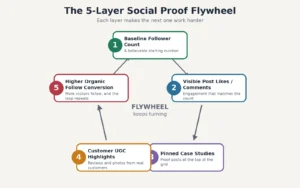
The flywheel only turns if layers four and five are real. Each customer photo or review you display gives the next visitor a reason to follow, which gives you more customers to ask. If you incentivise reviews, reward taking part, never a positive verdict. The FTC rule specifically prohibits paying for reviews of a particular sentiment.
Step 5: Display Quantifiable Milestones and Story Highlight Reviews
Quantifiable milestones give visitors something concrete to verify. Show real numbers, such as orders shipped, customers served or years trading, and file review screenshots in labelled Story Highlights, so visitors can judge your credibility at a glance before scrolling.
Create three to five Highlights with plain names: “Reviews”, “Results”, “How it works” and “Press”. Update them monthly. Celebrate milestones with a post when you cross a meaningful figure, such as your 500th order, but only claim what you can document.
Then measure. Track profile-to-follow conversion, meaning follows divided by profile visits, in your platform’s analytics each week, and note what you changed. Change one layer at a time so you learn which pillar moves the number.
The same five layers apply on every platform; only the location changes.
| Platform | Where the proof lives |
|---|---|
| Pinned grid posts, Story Highlights, bio link | |
| TikTok | Pinned videos, comment replies, profile bio |
| Featured section, recommendations, banner | |
| YouTube | Channel trailer, featured section, pinned comments |
| X | Pinned post, bio, replies |
Frequently Asked Questions
What is social proof on social media and why does it matter?
Social proof is visible evidence that other people trust your brand, including followers, likes, comments, reviews and customer content. It matters because visitors use it as a shortcut when judging an unfamiliar account, which affects whether they follow, click through or buy.
How can a brand-new account build social proof with zero followers?
Start with people who already know you: customers, email subscribers, partners and team. Publish three strong posts, pin them, add two or three review Highlights, then invite your existing audience to follow. Reach a few hundred genuine followers before paying for growth.
How many followers does a business need to look credible in 2026?
There is no verified threshold. Credibility usually depends more on consistent posting, specific comments, reviews and a healthy engagement rate than on a headline figure. A small account with real, recent proof can look more credible than a larger one with no engagement.
Do post likes and comments affect website conversion rates?
Likes and comments are social-proof signals, but their effect on website conversion is hard to isolate and not guaranteed. Where visitors arrive from social, credible engagement may reduce hesitation. Test it by comparing click-through and conversion on social traffic before and after changes.
What is the fastest way to get user-generated content (UGC)?
Ask recent customers directly, within days of delivery, for a photo or a one-line review, and make it easy with a tag, a hashtag or a simple form. Offer a thank-you for taking part, not for a positive verdict, and always get permission to repost.
Final Verdict
The fastest route to social proof is layered: real customer evidence on a well-organised profile, supported by a modest baseline of followers and engagement. Treat numbers as the supporting layer, not the proof itself, and measure profile-to-follow conversion to see what actually works.
Start this week with the free layers. Fix your bio, choose your three pins and ask five recent customers for a review. Those steps cost nothing and make every later investment in growth work harder.

Discussion