

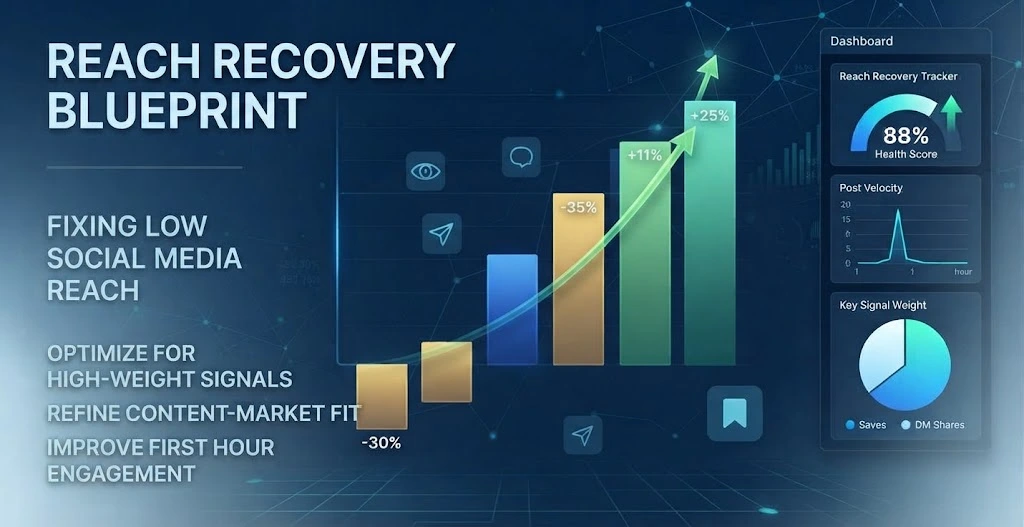
Quick Summary: To fix low social media reach in 2026, rule out account restrictions first, then strengthen the signals ranking systems lean on: watch time, DM shares and saves. Pair them with high-retention formats and a stronger first hour, and track recovery weekly.
5-Step Reach Recovery Checklist
| Step | Action | Success signal |
|---|---|---|
| 1. Audit | Check Account Status (Instagram) or Account check (TikTok) | No recommendation restrictions |
| 2. Signals | Give viewers a reason to save and send | Rising save and send rate per view |
| 3. Format | Test carousels and short-form hooks | Higher completion and swipe-through |
| 4. Velocity | Prime the first hour after posting | Faster early engagement |
| 5. Reset | Run the seven-day schedule | Reach trending above baseline |
Why Your Social Media Reach Dropped (The Shift to AI Interest Graphs)
Social media reach usually drops because ranking systems distribute posts by predicted interest, not follower relationships. When a post earns weak watch time, few shares and few saves early on, the algorithm has little reason to widen distribution and reach stalls.
Hootsuite’s 2026 algorithm analysis shows how far this shift has gone. Instagram separates connected reach (followers) from unconnected reach (everyone else), with likes weighing more for the first and sends for the second. TikTok favours discovery from accounts people do not follow. Follower count therefore offers limited protection: a large audience that scrolls past a post still produces weak signals.
Most cases of low reach on social media trace back to one of five causes, each mapped below to the step that fixes it.
| Symptom | Likely cause | Fix |
|---|---|---|
| Followers see posts, strangers do not | Recommendation ineligibility or restriction | Step 1 |
| Reach fell after reposting or reusing clips | Content classed as unoriginal | Step 1 |
| Plenty of views, few saves or shares | No reason to keep or send the post | Step 2 |
| Viewers leave within seconds | Weak hook, low retention | Step 3 |
| Slow first hour, flat afterwards | Low early engagement velocity | Step 4 |
Step 1: Audit Your Account Status and Remove Hidden Restrictions
Auditing account status means checking whether the platform has restricted an account or made its content ineligible for recommendation. On Instagram, professional accounts can see this in Account Status; on TikTok, Account check shows restrictions and For You feed limits for recent posts.
On Instagram, open the profile menu and tap Account Status. Professional accounts can then open Recommendations Guidelines to see whether a post, reel, bio or profile photo is limiting distribution to people who do not follow the account. Instagram’s Help Center notes that eligibility does not guarantee a post will be recommended, and that only public accounts are considered at all. A private account is therefore the first thing to rule out, and a personal profile needs switching to professional to unlock the recommendation view. On TikTok, Account check covers the last 30 posts and flags feature restrictions or videos held back from the For You feed, according to TikTok’s announcement.
Instagram has said that content breaking its Recommendation Guidelines can still reach followers while being withheld from non-followers. That pattern, normal results with the existing audience and almost none beyond it, is what creators usually call a shadowban. The documented equivalents are recommendation ineligibility and feature restrictions, and both surface in the tools above.
Originality is the second hidden restriction. On 30 April 2026, Instagram extended its originality rules from Reels to photos and carousels, so accounts that primarily post unoriginal content are no longer recommended, although followers still see the posts. Reporting on the announcement notes that credited screenshots do not count as original, and coverage lists watermarks and speed changes the same way, while added commentary or new graphics can qualify. Eligibility returns when most posts in a rolling 30-day period are original. Meta applies comparable rules to Facebook, and TikTok can make a whole account temporarily ineligible for the For You feed if it repeatedly posts content outside its standards.
Fixes are procedural: remove or edit flagged items, appeal decisions that look wrong, stop posting unedited reposts, and set the account to public. Then allow the 30-day window to roll before judging the result.
Step 2: Optimise for High-Weight Signals (Saves & DM Shares)
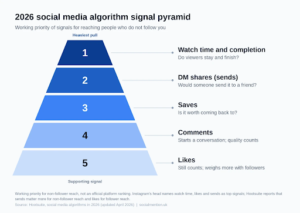
High-weight signals are the behaviours ranking systems treat as proof of value: watch time and completion, DM shares, and saves. Instagram’s head has named watch time, likes and sends as top signals, and saves are among the engagement predictions used for Explore.
Content earns saves and sends when it is worth keeping or passing on, which favours checklists, templates, step-by-step breakdowns and specific, relatable observations over generic motivation. Two ratios give a cleaner read than raw counts: saves divided by impressions (the save-to-impression ratio, often called save-to-view) and sends divided by impressions. Each post should be compared with the account’s own recent average rather than an industry figure, because niche and audience size change what “good” looks like.
Some creators go further and buy Instagram saves to boost algorithm signals, using paid saves to make a post look valuable in its opening hours. The appeal is clear, because saves are scarce, visible and tied to ranking. The limits are just as clear. Instagram’s Community Guidelines ask users not to artificially collect likes, followers or shares, so paid engagement carries policy risk. Saves from accounts with no interest in the topic also say little about real demand, and no purchase can fix a weak hook. If used at all, paid saves belong as a small supplement to content that already holds attention.
Step 3: Pivot to High-Retention Carousels and Short-Form Hooks
No single format guarantees recovery, but retention-led formats give ranking systems the clearest signals: Reels and carousels on Instagram, short-form video on TikTok. Hootsuite names these as each platform’s preferred formats in 2026; the hook decides whether viewers stay.
For short video, the first three seconds carry the most risk. The Reels ranking questions Instagram has published, as summarised by Hootsuite, include how likely a viewer is to watch for under three seconds and to watch more than 95% of the video. An opening that states the payoff immediately protects both numbers.
Carousels reward a different skill: sequencing. A reliable structure is a first slide that promises a specific outcome, one idea per slide across roughly seven slides, and a final slide that gives a reason to save or send. Seven is a working figure, not a platform rule.
Broadcast Channels do a different job. As a one-to-many channel for people who have chosen to join, they re-engage the existing audience rather than reach new people, which makes them useful for alerting followers when a post goes live. For more on timing and immediacy, see Social Mention UK’s article on real-time content engagement.
Step 4: Jumpstart First-Hour Post Velocity and Social Proof
Engagement velocity is how quickly a post collects views, saves, shares and comments after publishing. Most platforms do not document an exact test window, but social teams treat the first hour as the proving period, and Hootsuite notes LinkedIn explicitly weighs engagement in that first hour.
The practical levers sit with the creator: publish when the account’s own insights show the audience is active, reply to early comments quickly, share the post to Stories or a Broadcast Channel, and invite existing followers to send it to someone who would find it useful. Paid seeding is the optional extra lever, and providers such as the trusted growth platform SoldOutX are among those creators use for it.
Seeded engagement is a short-term nudge, not a substitute for retention. Because format and seeding changed together in the case above, Step 5 tests one variable at a time.
Step 5: The 7-Day Reach Reset Schedule for UK & US Audiences
A seven-day reach reset sequences the earlier fixes so each change can be measured. Day one audits status and records a baseline; days two to five test one variable at a time; days six and seven review results and keep what worked.
| Day | Action | Log |
|---|---|---|
| 1 | Check Account Status or Account check; record average reach, retention, saves and sends for the last 10 posts | Baseline |
| 2 | Publish a 7-slide educational carousel with a save-worthy final slide | Save-to-impression ratio |
| 3 | Publish a short video with a three-second hook | Completion rate |
| 4 | Repeat the stronger of the two formats and add a specific send prompt | Send rate |
| 5 | Prime the first hour: reply to comments, share to Stories or a Broadcast Channel | First-hour reach |
| 6 | Compare every metric with the Day 1 baseline | Change per metric |
| 7 | Keep the winning format, drop the weakest, fix or archive flagged content | Next week’s mix |
Posting slots should come from the account’s own insights, not generic best-time charts. The UK sits four to five hours ahead of the US East Coast depending on the time of year, so a UK early-evening post lands in the US early afternoon, a useful overlap for mixed audiences. After one cycle, repeat it with a new variable to keep addressing a declining reach trend.
Frequently Asked Questions
Why did my social media reach drop all of a sudden in 2026?
A sudden drop usually traces to recommendation ineligibility, unoriginal content, weak early watch time, or a platform format shift. Check Account Status or Account check first, then compare retention and save rates against the previous ten posts to find which signal weakened.
How long does it take to recover from a social media reach drop?
Recovery time depends on the cause. Instagram says accounts made ineligible for being unoriginal regain eligibility once most posts in a rolling 30-day window are original. Other fixes have no published timeline, so judge changes over five to seven posts.
Should I delete low-performing posts or archive them?
Archive posts that are outdated or off-brand, and delete those flagged in Account Status or containing errors. Deleting weak posts is not documented as a reach fix, and keeping them preserves data for comparing formats.
Does editing a caption after publishing hurt organic reach?
Instagram’s head, Adam Mosseri, has said in public Q&As that editing a caption after posting does not reduce reach. Corrections to wording or typos are safe; a stalling post is better helped by its hook or format than by repeated caption tweaks.
How do saves and first-hour likes help fix stalled reach?
Saves and early likes can give ranking systems proof that a post is worth testing on more people. Saves signal lasting value, while early engagement speeds that proof. Neither replaces watch time, and both work best when the content already earns completed views.
Final Verdict
Low reach is fixable when the cause is diagnosed first: check restrictions and originality, then improve watch time, shares and saves through retention-led formats. A stronger first hour can accelerate recovery, but it only works when the content already earns attention.
Start with Step 1 and log a baseline before changing anything, because every later decision depends on knowing whether the problem is eligibility, content or velocity. Creators weighing paid seeding should treat it as an optional supplement with policy risk, and test it against an unseeded post of the same format.

Discussion