

Quick Summary
Nano vs Micro-Influencers ROI (2026)
Evaluating nano vs micro influencers ROI in 2026 comes down to community intimacy versus operational scale: nano-influencers (1,000–10,000 followers) generate higher engagement rates (4.8%–8.0%) and niche trust, whereas micro-influencers (10,000–50,000 followers) deliver predictable conversion volume, lower management overhead, and faster campaign reach.
Marketing teams across the UK and the US no longer treat creator partnerships as vanity awareness exercises. As paid social customer acquisition costs fluctuate across Meta and TikTok, brand marketers and agencies scrutinise every pound and dollar against cost per engagement (CPE), verifiable checkout conversions, reusable content assets, and internal management hours. While celebrity and macro-influencer endorsements still serve mass-market television-style launches, smaller creator tiers consistently generate stronger commercial efficiency for direct-to-consumer (DTC), e-commerce, and regional service brands.
Yet treating all small creators as interchangeable is a costly mistake. A creator with 4,000 followers and a creator with 35,000 followers sit adjacent on the follower spectrum, but they operate through fundamentally different audience relationships, pricing structures, and production workflows. The head-to-head influencer tier comparison table below benchmarks both tiers across the core metrics defined in the LuvKaizen 2026 Micro-Influencer ROI Study alongside current UK and US campaign execution data.
| Comparison Metric | Nano-Influencers | Micro-Influencers |
|---|---|---|
| Follower Count | 1,000 – 10,000 followers | 10,000 – 50,000 followers (up to 100k on broad platforms) |
| Average Engagement Rate (ER%) | 4.8% – 8.0% (up to 10.3% on TikTok) | 2.5% – 5.0% (4.0% – 8.0% on TikTok) |
| Average Cost per Post / Reel (£ / $) | £80 – £200 / $100 – $250 (High product-gifting acceptance) | £300 – £800 / $400 – $1,000 (Flat fee or hybrid retainer) |
| Cost Per Engagement (CPE) | £0.02 – £0.45 / $0.03 – $0.57 (Rate-card basis; $3.11 median on tracked paid deals) | £0.10 – £0.48 / $0.12 – $0.60 (Rate-card basis; $3.05 median on tracked paid deals) |
| Niche Conversion Rate | 3.5% – 7.0% (High percentage conversion; low absolute orders per post) | 1.8% – 3.5% (Moderate percentage conversion; high absolute orders per post) |
| Best Campaign Goal | Product seeding campaigns, authentic UGC volume, hyper-local trust | Trackable e-commerce sales, paid social whitelisting, category reach |
| Management Time & Overhead | High (15–20 hours per 15 creators for sourcing, shipping, and chasing briefs) | Low to Moderate (3–4 hours per 3–5 professional creators with media kits) |
1. What Is a Nano-Influencer? (Pros, Cons & Best Use Cases)
A nano-influencer is a social media creator with 1,000 to 10,000 followers who maintains personal, peer-level relationships with a hyper-local or niche community, delivering a 4.8% to 8.0% average engagement rate at £80–£200 ($100–$250) per sponsored Reel compared with £300–£800 ($400–$1,000) for micro-influencers.
Unlike career digital talent, nano-creators are everyday enthusiasts—a club runner in Manchester, a specialty coffee home-brewer in Austin, or an aesthetician sharing ingredient breakdowns with friends, colleagues, and neighbours (RISER Collective). Because a large share of their audience knows them offline or shares a specific hobbyist identity, a product mention reads like a word-of-mouth tip from a trusted friend rather than a scripted advertisement. Cross-platform tracking in Pulse Advertising’s 2026 performance report shows nano accounts achieving 6.23% average engagement on Instagram and 10.3% on TikTok, far outpacing macro accounts that sit below 1.1%.
That community closeness makes the nano tier the primary engine for high-margin e-commerce seeding campaigns. Benchmark data from Zeth’s 2026 e-commerce ROI study demonstrates that nano-influencer cohorts generate an average 6.2x return on ad spend (ROAS)—the highest percentage return of any tier—when brands activate 15 or more creators simultaneously. Nano-creators are also the only tier where unpaid product gifting remains commercially viable: brands with a retail price above £35 ($45) and low cost of goods sold (COGS) can ship 50 product units and reliably secure 30 to 35 pieces of organic user-generated content (UGC) without paying cash appearance fees.
Before committing budget to nano-creators, brand marketers must weigh three structural trade-offs:
- Pros — Unmatched authenticity and low-cost UGC libraries: Nano-creators reply to nearly every comment in person, convert sceptical niche buyers, and supply diverse smartphone video hooks at a fraction of commercial studio production costs.
- Cons — Small per-post sample size and variable video polish: Because an individual nano post reaches a modest audience, a single Reel may drive only 3 to 8 tracked orders, while variable home lighting and audio mean roughly one in three clips will need editing before running as a paid ad.
- Best Use Cases — Hyper-local launches, product sampling, and social proof harvesting: Choose nano-influencers when opening a regional retail venue, seeding a new consumer packaged good across dozens of micro-communities, or building a library of testimonial clips for product detail pages.
2. What Is a Micro-Influencer? (Pros, Cons & Best Use Cases)
A micro-influencer is an established category creator with 10,000 to 50,000 followers (extending to 100,000 on some platforms) who balances a 2.5% to 5.0% engagement rate with professional content quality, outperforming nano-creators on per-post conversion volume and lowering campaign management time by 60%.
While older agency glossaries group everyone from 10,000 to 100,000 followers together, data-led buyers in 2026 concentrate their bookings between 10,000 and 50,000 followers. Empirical pricing research across OpenSponsorship’s 1,527 completed creator deliverables uncovered a sharp efficiency drop-off in the 50,000 to 250,000 follower bracket, which recorded the worst cost per view ($0.19) and worst median CPE ($7.07) of any tier. By contrast, micro-influencers in the 10k–50k bracket delivered the lowest median CPE across all paid deliverables at $3.05, capturing dedicated vertical authority—such as UK curly-hair care, B2B workflow software, or functional fitness—before talent management markups inflate per-post rates.
Creators at this stage operate as disciplined small businesses. Most have mastered how to get brand sponsorships as an influencer, meaning they approach partnerships with verified first-party audience insights, structured rate cards, reliable turnaround times, and a clear grasp of what makes a three-second video hook convert. Because their audience discovered them through topical expertise rather than personal acquaintance, a micro-influencer’s endorsement carries category authority that moves higher-ticket purchases (£75–£300 / $100–$400 average order value) where buyers look for an experienced specialist’s verdict.
Evaluating micro-influencers against your campaign requirements reveals clear operational strengths and boundaries:
- Pros — Statistically reliable conversion volume and broadcast-ready creative: A single micro placement routinely generates 25 to 60 tracked checkouts or lead captures—enough data to calculate per-creator CPA—while delivering crisp lighting, clear audio, and tight pacing suitable for immediate paid amplification.
- Cons — Mandatory cash budgets and lower gifting opt-in: Once a creator passes 20,000 followers, fewer than 15% accept product-only gifting; brands must allocate £300 to £800 ($400 to $1,000) per Reel or structure hybrid flat-fee-plus-commission agreements.
- Best Use Cases — Measurable DTC customer acquisition, national product launches, and long-term ambassadorships: Choose micro-influencers when you need predictable monthly revenue volume, clean UTM and promo-code attribution, and dependable multi-month brand ambassadors.
3. The £2,000 / $2,500 Budget Test: 15 Nano Creators vs 3 Micro Creators
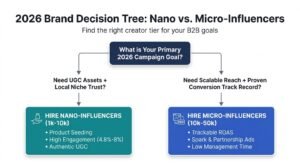
On a £2,000 ($2,500) campaign budget, hiring 15 nano-influencers generates 15 user-generated content (UGC) assets and a 4.8% average engagement rate across tight niche clusters, whereas hiring 3 micro-influencers delivers faster reach velocity, a 3.5% engagement rate, and one-fifth the coordination workload.
To see how micro-influencer vs nano economics play out in practice, consider a UK/US DTC brand allocating £2,000 ($2,500) to promote a £45 ($55) flagship product. Under Option A (15 Nano Creators), the brand spends roughly £133 ($166) per partner across 15 creators averaging 5,500 followers each, building a combined audience pool of 82,500 followers. Under Option B (3 Micro Creators), the brand invests roughly £666 ($833) per partner across 3 category specialists averaging 30,000 followers each, reaching a combined audience pool of 90,000 followers.
The decisive variable in this simulation is internal management overhead per pound or dollar spent . Vetting 15 nano profiles, negotiating 15 separate usage agreements, dispatching 15 parcels, and chasing 15 draft edits consumes 15 to 20 hours of staff time. At a fully loaded agency or in-house marketer rate of £35 ($45) per hour, those 18 hours add £630 ($810) in hidden operational cost—lifting Option A’s true cost to £2,630 ($3,310) and stretching launch timelines to four weeks. By contrast, contracting 3 professional micro-creators requires just 3 to 4 hours of briefing and review (£122 / $157 in staff time), putting campaigns live within 10 days at a total cost of £2,122 ($2,657).
Your optimal choice in this £2,000 / $2,500 test depends on your primary bottleneck. If your paid media team lacks diverse creative angles and you have an automated seeding workflow, Option A gives you 15 distinct video hooks (~3,960 total engagements at 4.8% ER) that can be tested across Meta and TikTok ad sets. If your priority is rapid revenue generation within the current quarter and your marketing team is lean, Option B delivers concentrated reach velocity (~3,150 engagements at 3.5% ER) and clear per-creator ROAS attribution without administrative bottlenecks.
4. How to Amplify Creator Campaign Posts for Maximum ROI
Campaign amplification combines organic creator trust with paid whitelisting, Spark Ads, and early-hour engagement velocity boosts, increasing sponsored Reel distribution by 2x to 4x across both nano and micro tiers while cutting blended cost per acquisition (CPA) below standalone paid social benchmarks.
Even the best-scripted creator video can underperform if left entirely to unassisted organic distribution. Recommendation engines on Instagram Reels, TikTok, and YouTube Shorts judge every newly published post during a narrow 60- to 120-minute initial testing window: posts that attract rapid watch-time completion, saves, shares, and comments are graduated into non-follower discovery feeds, while posts with slow early interaction are throttled. To overcome algorithmic friction on sponsored launches, growth teams combine organic creator posting with SoldOutX creator campaign scaling so high-converting Reels capture immediate first-hour momentum.
Before (Macro Bet): A UK functional beverage startup spent £1,800 on a single sponsored Reel with one lifestyle macro-influencer (140,000 followers). Broad audience mismatch produced weak watch time and generated only 19 website orders (£94.74 CPA).
After (Micro Portfolio + First-Hour Amplification): The next month, the brand split the exact same £1,800 budget across four UK wellness micro-influencers (15,000–25,000 followers each) and boosted first-hour likes and saves on all four sponsored Reels via SoldOutX. That early velocity triggered algorithmic distribution into Explore and non-follower feeds, generating 68,000 combined views, 142 tracked website orders (£12.68 CPA), and a 3.8x ROAS.
To replicate that performance systematically, apply a three-stage amplification protocol to every campaign wave:
- Ignite first-hour social proof and algorithmic velocity: Coordinate creator comment replies immediately upon publishing and pair key launches with targeted reach, save, and interaction packages—modelled on verified influencer campaign results from SoldOutX—to push sponsored Reels past initial algorithmic thresholds and build visible social proof for link clickers.
- Scale winning posts through paid whitelisting: Lock in 60-day Meta Partnership Ad and TikTok Spark Ad permissions inside your initial creator contract; running paid traffic through a creator’s native handle rather than a corporate brand page increases click-through rates and drives up to 3x higher conversion efficiency (Digital Applied).
- Syndicate top clips across high-intent checkout touchpoints: Embed your highest-retention nano and micro video reviews directly onto e-commerce product pages, landing pages, and abandoned-cart email sequences to lift site-wide conversion rates long after the initial social post peaks.
5. Which Tier Should Your Brand Choose in 2026? (Decision Checklist)
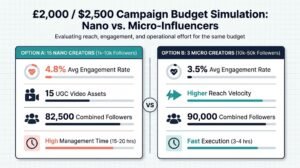
Brands should choose nano-influencers when prioritising high-volume UGC libraries, product seeding, and hyper-local trust on limited cash budgets, and choose micro-influencers when requiring statistically significant conversion tracking, polished creative assets for paid social whitelisting, and scalable multi-market reach with minimal internal management.
Rather than treating nano and micro tiers as mutually exclusive, mature brands align their creator mix to their quarterly growth stage using this five-point decision checklist:
- Adopt a 70/30 portfolio split once budgets exceed £5,000 ($6,000): Allocate 70% of your performance creator spend to micro-influencers for trackable conversions and whitelisted ads, and dedicate 30% to always-on nano seeding so your creative pipeline never runs dry (Syncly).
- Filter tier selection by product unit economics: Use gifted seeding plus 15%–20% affiliate revenue share with nano-creators when your product has low manufacturing cost and broad impulse appeal; deploy flat fees plus CPA bonuses with micro-creators when selling considered, higher-margin products.
- Audit comment quality and sponsored-to-organic retention: Before signing any creator, verify that their recent sponsored Reels achieved at least 70% of their organic view median, inspect comments for genuine product questions rather than bot emoji strings, and confirm 60%+ audience concentration in your target UK or US geography.
- Mandate upfront regulatory disclosure and usage licensing: Require clear #Ad or Paid partnership labels at the very start of captions and on-screen overlays in line with UK Advertising Standards Authority (ASA) guidance and US Federal Trade Commission (FTC) endorsement rules, and bundle 60-day paid whitelisting rights into the initial fee.
- Transition top-converting one-offs into recurring retainers: Track link clicks, save-to-view ratios, and promo code redemptions across every cohort, then re-book the top 20% of performers on three-month packages where repeated audience exposure compounds trust.
Frequently Asked Questions
Comparing nano and micro-influencers requires evaluating follower thresholds, cost per engagement (CPE), conversion tracking requirements, and post-publication amplification tactics; the direct answers below summarise the essential 2026 benchmarks for UK and US marketing teams planning creator budgets.
1. What is the difference between a nano-influencer and a micro-influencer?
A nano-influencer has 1,000 to 10,000 followers and influences a close-knit, often personal or hyper-local community with 4.8%–8.0% engagement, whereas a micro-influencer has 10,000 to 50,000 followers (up to 100,000 on some platforms) and operates as a professional niche specialist with 2.5%–5.0% engagement.
2. Do nano-influencers or micro-influencers deliver better ROI for brands?
Nano-influencers deliver higher percentage return on ad spend (up to 6.2x ROAS) and lower cost per UGC asset in product seeding campaigns, whereas micro-influencers deliver stronger total revenue volume and ~4.1x ROAS in performance campaigns because each placement generates enough conversions to optimise.
3. What is the average engagement rate for nano vs micro-influencers in 2026?
In 2026, nano-influencers average 4.8% to 8.0% engagement across platforms—reaching 6.23% on Instagram and 10.3% on TikTok—while micro-influencers average 2.5% to 5.0% overall, consistently outperforming macro and mega creators who sit between 0.9% and 1.5%.
4. When should a brand hire micro-influencers instead of nano-creators?
Brands should hire micro-influencers instead of nano-creators when they need statistically meaningful conversion data per post, broadcast-ready video assets for paid social whitelisting, national rather than neighbourhood reach, and a streamlined workflow managing three to five partners instead of thirty.
5. How do brands boost the reach of sponsored influencer posts?
Brands boost sponsored post reach by whitelisting creator handles through Meta Partnership Ads or TikTok Spark Ads, syndicating top-performing Reels across product pages, and accelerating first-hour likes, saves, and shares so social algorithms push the content into non-follower discovery feeds.
Final Verdict
Neither creator tier wins in isolation: nano-influencers (1k–10k) are unmatched for low-cost UGC production, product gifting, and grassroots credibility, while micro-influencers (10k–50k) are the superior performance engine for trackable e-commerce conversions, rapid campaign deployment, and scalable paid amplification in 2026.
For brands launching with a £2,000 ($2,500) test budget, book 3 to 4 vetted micro-influencers in your core vertical and reserve 15% of your spend to boost first-hour engagement and Spark/Partnership ad delivery on the top-performing Reels. Once you have proven which creative angles convert your target buyers, layer in an always-on nano-influencer seeding programme to feed your ad account and product pages with fresh community proof every month.
