


Quick summary
To scale social media for agencies, standardise onboarding and 90-day KPIs, run a repeatable monthly batching cycle, agree how early wins are measured, tie posts to enquiries, and automate approvals and reporting. These steps help one team manage more client accounts without losing quality.
| Area | Standardise this | Review monthly |
|---|---|---|
| Onboarding | Business objectives, KPIs and a 90-day expectations sheet | Are agreed KPIs moving as planned? |
| Production | Monthly batching SOP and shoot calendar | Assets delivered against the plan |
| Early wins | First-30-day plan with agreed early-win metrics | Reach, saves, shares and enquiries |
| Funnels | UTM tracking and a lead log for each client | Leads by source |
| Approvals | One approver per client and a fixed review window | Average approval turnaround |
| Reporting | One-page monthly ROI report template | Reports sent on schedule |
When agencies struggle to manage more accounts, the bottleneck is usually operational rather than creative. Onboarding often varies by client, production restarts from scratch each month, approvals have no deadline and reports describe activity instead of results. This guide is for UK and US agency owners, account directors and freelancers who manage 10 to 50 or more client accounts and want a system they can repeat. Each section covers one operational pillar with a practical standard you can adopt.
1. Standardise Your Client Onboarding and 90-Day KPI Expectations
Onboarding sets the terms for everything that follows. Before content goes live, agree on two or three business objectives, the metrics that measure them and what a realistic first 90 days looks like. Put it in writing so the client, not your team, defines success.
A repeatable onboarding process removes the guesswork that makes clients anxious. Use the same intake form, discovery call and kickoff checklist for every account, and adapt only what differs, such as platforms or industry. The intake should capture brand voice, approval contacts, existing assets, posting history and the business goals the client cares about most.
Next, write a 90-day KPI sheet with three to five metrics. Tie at least one metric to a business outcome, such as enquiries or bookings, rather than follower count alone. Set expectations stage by stage: days 1 to 30 establish the baseline, content pillars and first batch; days 31 to 60 should show early trend lines; day 90 should demonstrate the agreed outcomes. A written timeline gives both sides a shared reference when early numbers move slowly.
Finally, agree on the reporting cadence, the approval owner and the definition of every metric. Track client retention rate alongside these KPIs, so renewal conversations start from data. Define engagement rate once and use the same formula every month. One common approach divides interactions by reach. Without fixed definitions, a change in method can look like a change in performance.
2. Build a Modular Content Batching and Repurposing Pipeline
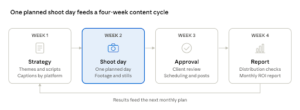
Batching means producing a month of content in one planned cycle rather than post by post. A four-week SOP covering scripting, a single shoot day, approvals and scheduling, then reporting, lets one team service many accounts with predictable output.
Week one covers strategy and scripting: the strategist maps the month’s themes to the goals agreed at onboarding, then writes scripts and captions. Week two is the shoot. One planned day captures enough footage and stills for the month, and editors cut them into formats for each platform. Week three handles client approval and scheduling. Week four covers distribution checks and reporting, so the cycle closes with data that feeds the next month’s plan.
Batching cycle · four weeks, one shoot day
The repurposing layer turns one shoot into a month of posts. A long-form clip can become several short vertical videos, quote graphics, carousels and story frames, each captioned for its platform rather than pasted across all of them. Keep a shared asset library with file-naming rules, so anyone on the team can find the right version without asking.
Set a fixed output target per client, such as a set number of short videos and static posts, so production stays predictable. Use the same content SOP for every account, then adjust the content mix for each brand. The first cycle takes longer while templates are built, so log hours per client each cycle. If the templates work, hours per client should fall over the first few cycles.
3. Deliver Fast First-30-Day Client Wins with Growth Partners You Can Vet
Clients often judge an agency on its first month, when early results show up in reach, engagement and enquiries. Growth partners can support that visibility, but only when their methods are transparent, expectations are realistic and bought activity is reported separately.
Early doubts often form in the first 60 days. If follower numbers stagnate while the team is busy producing content, clients may read the silence as lack of progress, even when reach, saves or enquiries are moving. Agree the early-win metrics during onboarding, so the first report shows movement on the measures the client chose, not only on the headline follower count.
Mini case study: a four-person UK boutique agency
Before the change, this four-person UK boutique agency was losing 35% of its new clients after Month 2. The cause was slow early follower traction on brand-new accounts. At that point, 90-day client retention stood at 65%, and the agency had 8 active retainers.
The agency built SoldOutX wholesale growth packages into its First-30-Day Onboarding SOP, running them alongside batch Reel production. Growth support and regular content sat in one plan rather than in separate experiments.
The results: 90-day client retention rose to 94%, and the agency scaled from 8 to 22 active retainers. Here, retention means the share of clients still active at 90 days.
Growth partners can help when they sit inside a documented plan. Start with SoldOutX wholesale agency solutions if you want a packaged option, and review the proven social media campaign results from SoldOutX before you commit.
Due diligence matters more than the package. Ask every provider how engagement is produced, whether it comes from genuine accounts and how that activity will appear in your reports. Avoid anyone who guarantees follower numbers or engagement. Meta publishes its rules on inauthentic behaviour, and platforms can remove inauthentic activity or restrict accounts. The outcome is hard to predict, so treat growth support as one input in a longer plan, not a substitute for content that performs.
Keep bought or partner-supported activity separate from organic results in every report. If a client’s numbers jump without matching gains in comments, saves or enquiries, explain what changed rather than showing the headline figure alone.
4. Connect Client Content to Revenue-Generating Funnels
Content that never reaches an enquiry or sale is hard to defend at renewal. Map each client’s posts to a funnel stage, set a tracking method for each stage, and make the monthly report show which content generated leads, not just reach.
Start by agreeing on the conversion action for each client. For some it is a form submission or booking; for others it is a direct message or an in-store visit. Use a consistent tracking setup: UTM parameters on every link you control, such as bio links, ad destinations and newsletter links, dedicated landing pages for campaign traffic, and a shared lead log for direct messages that become leads once the client confirms interest.
Give each content type a job. Awareness formats, such as short videos, introduce the brand to new viewers. Consideration formats, including case studies, explainers and FAQ posts, answer the questions buyers ask before enquiring. Conversion formats, such as offers and booking prompts, ask for the action directly. A calendar that mixes all three stages avoids posting only one kind of message.
For the stage-by-stage setup, see our guide on building high-converting social media funnels. Once the funnel is mapped, the monthly report can show leads by content type and source, which gives renewal conversations evidence instead of impressions.
5. Automate Approval Workflows and Monthly ROI Reporting
Approvals and reporting need fixed rules to stay predictable. Assign one approver per client, set a review window and keep a single shared calendar. Automate publishing and data collection, then spend the saved time on the commentary clients pay for.
Write the approval process into each client’s SOP. Define who approves, how long they have to respond and what happens when the window closes. A 48-hour review window with a reminder on day two is one workable example. Store approved versions in one place, so a change request does not leave two copies in circulation.
Sample one-page client ROI report (template layout)
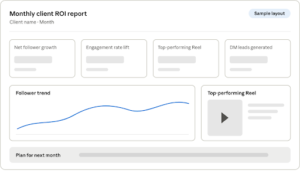
Monthly client ROI report, sample layout
Sample report layout. Real figures come from each client’s own data.
The monthly report should fit on one page. A workable structure covers net follower growth, engagement rate lift, the top-performing Reel and the number of direct message leads generated. Define each metric before the first report. Net follower growth is new followers minus unfollows over the period, and lift should be the percentage change against the previous period.
Automation covers the repetitive work: scheduling, publishing, data pulls and dashboard refreshes. A multi-account dashboard can show every client’s core KPIs in one view, so account managers spot a slow client before the monthly call. Keep the commentary manual. A report that explains what changed, why it changed and what you will test next is more useful to a client than a dashboard on its own.
Frequently Asked Questions
These questions cover the points agency owners ask most when scaling: account capacity, early cancellations, safe growth tactics, reporting and white-label services. Each answer stands alone.
How do social media agencies manage 20+ client accounts efficiently?
They standardise the work. Each client gets the same onboarding form, monthly batching cycle, single approver and one-page report. A shared calendar and scheduling tool handle publishing, so account managers can focus on strategy and client conversations.
Why do clients cancel social media retainers in the first 60 days?
Early cancellations often follow unclear goals, slow visible progress or too little communication. If follower counts stall and reports only describe activity, clients may assume the agency is not delivering. Agreed KPIs and a steady reporting rhythm reduce that risk.
How can agencies deliver fast follower and engagement wins safely?
Start with organic actions: consistent posting, quick replies to comments, relevant creator collaborations and native platform features. If you use a growth partner, choose one that explains its methods, avoids guarantees and reports bought activity separately. Check platform rules first.
What should be included in a monthly agency social media report?
Include the KPIs agreed at onboarding, a one-line definition of each metric, top and bottom posts, enquiries by source and two or three recommendations for next month. Keep it to one page and separate paid or partner-supported activity from organic results.
How do white-label social media growth services work for agencies?
A white-label provider delivers the work under your agency’s brand, so clients deal only with you. You pay for the service, choose what to present and remain accountable for results. Check what is delivered, and how, before you resell it.
Final Verdict
Scaling social media for agencies depends on repeatable systems: standard onboarding, a batching SOP, a clear approval process and one-page reporting tied to agreed goals. Start with the step your team skips most often, then tighten the rest one client at a time.
Start by documenting one process this month rather than rebuilding everything. Onboarding and reporting shape client expectations directly, so they are a sensible place to start. Add batching once shoot and approval steps are predictable, and treat growth partners as one input among several, with clear limits and transparent reporting.
