


Growing a social media audience in the UK takes more than posting regularly. Successful creators combine audience research, British cultural relevance, consistent publishing, credible social proof and a clear monetisation strategy.
Whether you’re building a personal brand in Manchester, running a small business in London or creating content for an international audience, these six strategies will help you make better decisions about where, when and what to publish.
QUICK SUMMARY
The best social media strategy for UK creators is to publish content tailored to British audiences, test evening posting windows, collaborate with relevant local creators and build genuine engagement. Strong audience insights, consistent storytelling and transparent brand partnerships support sustainable growth.
UK social media platforms at a glance
Instagram: visual discovery, lifestyle, beauty, fashion and local businesses. TikTok: short-form entertainment, food, tutorials and youth-oriented content. YouTube: educational videos, reviews and searchable long-form content. Facebook: community-based marketing and local businesses. LinkedIn: business owners, consultants and B2B creators.
According to Sprout Social’s UK social media demographics report, YouTube and TikTok attract substantial attention from younger adults, while Facebook remains important for older audiences. Creators should select platforms based on audience fit, rather than following every trending network.
1. Train the Algorithm to Reach High-Value UK & US Audiences
Instagram and TikTok recommend content using signals such as viewer behaviour, engagement and video information. UK creators can improve their chances of attracting relevant British and American audiences through locally meaningful topics, clear captions, consistent content themes and strong viewer retention.
Step 1: Identify the audience you want to attract
Before producing another Reel or TikTok, define your ideal viewers. A Manchester food creator targeting British restaurants needs different content from a finance creator hoping to reach professionals in London and New York. Write down three characteristics: location, interests and the problem your content helps solve.
For example, a UK fitness creator might target people interested in affordable home workouts. That audience definition can guide subjects, storytelling and partnerships.
Step 2: Make your location relevant in the content
Instagram and TikTok need context to understand a video’s subject. Mention relevant UK cities naturally, use precise phrases such as “Manchester brunch spots”, add genuine location tags and work with creators whose audiences match the target market. Location references can improve relevance but cannot guarantee country-specific distribution.
A caption saying “Three affordable restaurants worth visiting in Birmingham” explains much more than “My favourite places”.
Step 3: Prioritise watch time and audience satisfaction
TikTok’s For You recommendation explanation identifies interactions, video information and account settings as recommendation factors. Your opening seconds should establish a reason to continue watching. For instance, “This Manchester café serves a full breakfast for under £10” offers a specific and locally useful promise.
Step 4: Expand into the US without losing your UK identity
To reach American viewers, experiment with topics relevant to both markets. Technology reviewers can compare prices in pounds and dollars. Finance creators can explain how UK ISAs differ from US retirement accounts, while keeping the rules distinct.
International scheduling is worth testing, but US views do not automatically earn more: ad rates and sponsorship value vary with audience, niche and campaign. Check country-level reach before expanding your international publishing plan.
2. Publish Around Verified UK Commute and Evening Peak Hours (GMT/BST)
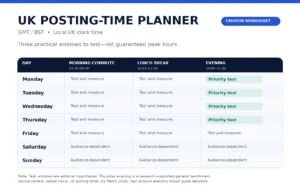
UK engagement research offers a starting point for scheduling, with evening hours particularly relevant on several platforms. Commutes and lunch breaks are useful experiments, but creators should validate every proposed window against their own audience data rather than treat it as a universal peak.
Sprout Social’s March 2026 UK posting-time study analysed over 230 million UK-specific brand engagements and found Thursday, especially 4–11 p.m. GMT, its strongest general day and period. Brand engagement benchmarks are informative but cannot predict individual creator results.
The UK uses GMT in winter and British Summer Time (BST), one hour ahead, in summer. If a source specifies fixed GMT, convert to BST as needed. A scheduling tool set to Europe/London should handle the seasonal clock changes automatically.
Build a four-week timing experiment
Choose three repeatable content formats: tutorials, personal stories and product demonstrations. Rotate their publication times over four weeks, keeping subject, length and production effort reasonably comparable. Record watch time, saves, shares, profile visits and UK audience reach for each upload.
Engagement rate by reach = (likes + comments + shares + saves) ÷ reach × 100. Compare results across multiple posts, not a single outlier. Schedule more content when meaningful audience responses consistently appear.
3. Blend British Cultural Relevance with Viral Short-Form Formats
British creators can strengthen their content by combining familiar local experiences with clear short-form storytelling. Regional humour, relevant trends, locations and creator collaborations work best when they serve an interesting idea rather than exist only to chase impressions.
Use relatable British experiences
A London lifestyle creator might document a realistic weekly supermarket budget. A Leeds student could share affordable campus life. A Birmingham food reviewer might compare independent takeaways. Each idea makes the intended audience and benefit immediately clear.
British humour can work when it reflects the creator’s real personality. Avoid forcing regional slang or stereotypes into every video; a recognisable voice is more sustainable than imitating a trending sound.
Develop three repeatable content series
Local discoveries: useful or overlooked places in a specific UK city. Practical advice: tutorials and comparisons solving recurring questions. Behind the scenes: honest creator processes, decisions and lessons. Repeatable formats reduce production work and make performance easier to compare.
For more ideas about hooks, shareability and content structure, see how to go viral on social media.
Collaborate with creators who share your audience
A Manchester fitness creator might gain more from collaborating with a local nutritionist than from a much larger, unrelated account. Suggest one useful concept, such as comparing affordable high-protein foods from UK supermarkets. Judge success by relevant profile visits, UK audience growth and enquiries, not views alone.
4. Build Strong Local Credibility and Social Proof
British brands typically care about audience relevance, engagement quality, content standards and professional presentation. A credible profile makes its niche obvious, shows meaningful interactions and provides evidence of the local reach that potential collaborators want to buy.
Start with an informative biography, a coherent set of recent posts and visible ways to contact you. For example: “Manchester food creator | Honest restaurant reviews, affordable eats and independent cafés | Brand collaborations: email”. A potential sponsor should understand your speciality within a few seconds.
ILLUSTRATIVE MINI CASE STUDY — MANCHESTER
Imagine a Manchester food creator with 2,100 followers and a hypothetical 38% UK audience share. The campaign plan tests posts at 6:45 p.m. UK time, uses authentic Manchester restaurant coverage, adds relevant location information and collaborates with local accounts. Weekly reporting tracks UK audience share, saves, enquiries and profile visits. A brief could set goals of 8,200 followers, 74% UK reach and three restaurant partnerships. These are planning targets, not documented customer results. The example demonstrates how to organise a measurable campaign without claiming that a particular tactic or supplier delivered those outcomes.
Compare ways to develop your audience
Creator growth can involve consistent publishing, collaborations, platform advertising and external promotional services. Someone researching UK-targeted follower growth via SoldOutX can compare the service’s advertised packages with alternative promotion methods. SoldOutX also lists related Instagram engagement products.
Before using a third-party service, check its audience-location claims, account authenticity, delivery terms and the platform’s policies. Follower totals do not prove that an account has genuine UK attention: first-party country analytics, real comments and repeat engagement are stronger evidence for a sponsor.
Build a media kit brands can assess
Include your niche, recent reach, audience geography, engagement, example content and reporting period. A Leeds restaurant may find an engaged West Yorkshire audience more valuable than a much larger but geographically irrelevant following. Avoid invented statistics or unsourced testimonials.
5. Diversify Revenue Across UK Brand Sponsorships and Social Commerce
UK creators can combine sponsorships, affiliate work, platform monetisation, products and services. The best mix depends on audience trust, niche and eligibility. Several compatible revenue streams can reduce reliance on volatile views or any single platform’s payout scheme.
Step 1: Define your commercial offer
Describe what the sponsor receives. A UK skincare creator might produce one demonstration Reel with follow-up Stories. A local travel creator could offer a destination video and an informative visitor guide. Specify content format, revision expectations, publication timing and usage rights.
Step 2: Pitch businesses that fit your viewers
Contact businesses that share your geographical and topical audience. A Bristol home-improvement creator could approach local interiors shops; a Birmingham food creator could approach suitable restaurants. Lead with a content concept and audience match rather than follower count alone.
Step 3: Compare monetisation routes
Brand sponsorships: agreed fees for defined content, with audience attention fit. Affiliate marketing: commissions on qualifying sales, with transparent disclosure. YouTube monetisation: revenue-sharing features for eligible channels, with no guaranteed income. Digital products: useful guides or templates that meet demand. Social commerce: direct product discovery and sales on supported platforms.
YouTube’s official earnings guidance explains that earnings are not guaranteed, even where revenue-sharing is available.
Step 4: Check profitability and build repeat partnerships
If a brand pays £300 for a campaign and production plus travel cost £100, the creator retains £200 before tax and other business costs. Record time spent as well as expenses. After publishing, send the partner a concise report with reach, relevant audience information and attributable clicks or sales where available. Reliable delivery encourages repeat work.
6. Stay Compliant with UK ASA (#Ad) Disclosure Guidelines
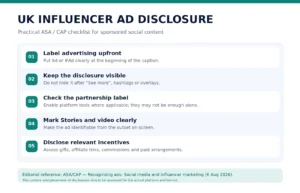
UK influencers must make advertising content clearly identifiable when commercial relationships require disclosure. The Advertising Standards Authority expects upfront, prominent labels, while UK guidance also covers paid endorsements, gifts, commissions and relevant incentives.
According to the ASA/CAP guidance on recognising influencer ads, a conspicuous “Ad” or “#Ad” label near the start is generally a sound approach. Brand mentions, discount codes or vague terms such as “gifted” are not reliable alternatives. Instagram’s Paid Partnership tool may help but may not be sufficient alone.
Check that viewers can identify promotional Stories and short videos at the outset, including when captions are not visible. Spoken disclosure can add clarity, but it is not a universal substitute for a visible label. The UK government’s social media endorsement guidance explains businesses’ responsibilities alongside those of creators.
Frequently Asked Questions
What are the best times to post on social media in the UK (GMT/BST)?
UK research highlights Thursday evenings, especially 4–11 p.m. GMT, as a strong general benchmark. Platform patterns vary, so test commuting, lunch and evening hours in UK local time, then use your own account analytics to identify consistent engagement rather than assuming one ideal publishing slot.
How do I make sure my Reels and TikToks reach UK viewers?
Publish content genuinely relevant to British viewers using suitable topics, locations, language and collaborations. Review the country-level audience breakdown regularly. No tag, publishing hour or technical setting can guarantee UK distribution, since recommendation systems consider multiple signals.
What are the UK ASA rules for influencers declaring sponsored posts?
Influencer ads must be clearly recognisable as advertising. Use a prominent upfront Ad label where required, including for relevant brand, gifted and affiliate arrangements. Platform disclosure tools can help, but check visibility before someone engages with the content.
Which social media platform pays UK creators the most in 2026?
There is no universally highest-paying platform. YouTube provides established monetisation features for eligible channels, while TikTok, Instagram and other platforms can generate revenue through brand partnerships and commerce. Earnings vary by audience, niche, eligibility, geography and agreement.
How can new UK creators build follower credibility quickly?
Choose a recognisable niche, publish useful content, present your profile professionally and collaborate with credible peers. Show genuine engagement and country-specific analytics where appropriate. Brands can assess an engaged, relevant audience more meaningfully than a bare follower count.
Final Verdict
The most effective social media strategy for UK creators combines clear audience positioning with regular experimentation. Choose platforms that match your viewers, create useful and culturally relevant content, test posting times and build professional relationships that lead to genuine commercial opportunities.
Begin with one primary channel, three repeatable content formats and a monthly review of watch time, meaningful engagement and audience geography. As your presence matures, expand through relevant collaborations, thoughtfully assessed promotion and transparent brand partnerships.
Aim for a recognisable, credible creator brand not merely a bigger follower number.

Discussion