

Social media engagement grows when content gives people a clear reason to stop scrolling, react, save, share or join a conversation. To boost social media engagement fast, combine stronger opening hooks, useful carousels, interactive formats, timely community replies and evidence-led publishing decisions.
Successful creators do more than accumulate likes. They turn passive viewers into people who revisit their content, recommend it to friends and participate in relevant discussions. The following ten methods explain how to increase engagement on social media without relying on unsupported algorithm claims.
Quick Summary
Improving social media engagement starts with attention and relevance. Use compelling three-second hooks, educational carousels, specific comment prompts, interactive Stories, collaborations and timely replies. Measure saves, shares, comments and engagement rates to identify what consistently motivates audience participation.
Social Media Engagement Rate Benchmarks in 2026
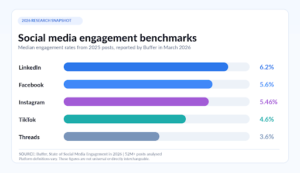
Benchmarks vary by platform, audience size and calculation method. Buffer’s 2026 report analysed more than 52 million posts and reported the following typical median engagement rates for 2025 in its dataset:
| Social platform | Median engagement rate |
| ≈ 6.2% | |
| ≈ 5.6% | |
| ≈ 5.46% | |
| TikTok | ≈ 4.6% |
| Threads | ≈ 3.6% |
Source: Buffer’s State of Social Media Engagement in 2026. These are not universal averages: networks define and collect engagement differently, so compare similar accounts and use a consistent method.
1. Engineer 3-Second Visual Hooks to Stop the Scroll
A strong three-second hook gives viewers an immediate reason to continue watching. Rather than introducing a brand at length, begin with a recognisable problem, visual demonstration or specific outcome connected to the audience’s interests.
A fitness creator, for example, could replace “Here are some workout tips” with “Your squat form might be making every repetition harder”. The second opening identifies a problem and creates curiosity without exaggeration.
For a better hook, identify one audience problem, show a relevant outcome in the opening frame, add concise on-screen text that works without sound, and deliver the promised explanation promptly. Test several openings and compare early retention rather than assuming one format always wins.
If a video receives limited distribution despite a clear opening, investigate related factors in this guide to fixing low social media reach. Measure three-second retention, average watch time and the proportion of viewers who reach the central explanation.
2. Optimise for Saves and DM Shares Over Passive Browsing
Saves and direct-message shares show that content can be useful beyond a single viewing. Practical checklists, examples, reference guides and meaningful comparisons offer viewers a reason to revisit information or recommend it to someone else.
A small business could publish a “Plan a week of Instagram content in 20 minutes” checklist. Its closing prompt might say “Save this checklist for your next planning session”, because that action matches the value supplied. By contrast, a relatable experience or timely discovery may be more naturally shared.
Use a save-to-like ratio of (saves ÷ likes) × 100 and a share-to-reach rate of (shares ÷ accounts reached) × 100 as diagnostic measures, not as universal ranking factors. Compare posts of similar age and format. When a topic consistently earns more saves or shares, create deeper follow-up material.
3. Use Multi-Slide Carousels with Open-Loop Storytelling
Multi-slide carousels allow viewers to explore one topic progressively. The first slide should make a clear promise; subsequent slides should provide distinct steps or evidence, rather than spreading a simple idea across unnecessary panels.
For example, “Seven Instagram mistakes that reduce audience interaction” makes a clearer opening than “Marketing tips”. A seven-slide sequence can move from the hook to four useful steps, then a demonstration or verified example, and finally a save-or-comment invitation.
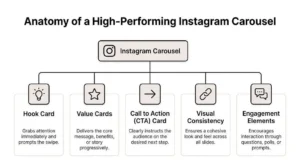
Use the number of slides the material requires. Compare saves, shares and comments across carousels, short videos and single-image posts. Do not infer that swiping through a slide automatically produces a ranking benefit; the useful outcome is that audiences understand and value the material.
4. Spark Active Discussions with Specific Comment Triggers
Specific questions make participation easier because viewers immediately understand the decision or experience they are being asked to share. Choose a prompt that connects to the content, rather than a generic request such as “What do you think?”.
A creator might ask, “For a small business, would you prioritise Instagram Reels or TikTok videos for the next 30 days?” The resulting answers can develop into helpful exchanges when the creator asks follow-up questions and responds to different opinions.
Discussion starters work best when they invite comparisons, practical experiences or constructive disagreement. Creators can pin a relevant comment to give later visitors a clear starting point for the conversation.
Some businesses also consider third-party services, such as SoldOutX’s custom Instagram comments to spark discussions. Any promotional comments should not be presented as independent customer experiences; creators should check Instagram’s policies and the authenticity of interactions before using such options. Track relevant comments and genuine follow-up replies, not simply raw comment totals.
5. Leverage Interactive Story Stickers and Broadcast Channels
Interactive Stories reduce the effort needed to participate. Instagram polls, emoji sliders and question stickers invite quick responses while helping creators discover topics that interest their audiences.
A clothing brand could let viewers choose between two upcoming designs. A fitness creator could use a slider to gauge interest in a new workout. A marketing consultant might ask whether followers struggle most with reach, planning, comments or conversions. Each response informs the next piece of content.
Try a weekly rhythm: an opening poll, a midweek question sticker and a follow-up Story sharing the outcome. Eligible creators can use Instagram broadcast channels for updates and supported interactive content directed at people who opt in to join.
These formats can improve participation but do not automatically double it. Measure response volume relative to Story viewers and whether feedback leads to helpful new posts or conversations.
6. Pin Top Comments and Reply Within the Golden Hour
The first hour after publication is a useful opportunity to answer questions while a post is fresh. Prompt, thoughtful replies support community discussion, although there is no reliable universal rule that the first 60 minutes determine 80% of eventual reach.
After publishing, reply to genuine questions, acknowledge useful contributions and pin a comment that clarifies the subject or introduces another relevant perspective. A meaningful answer encourages further conversation more effectively than repeated generic thank-you replies.
One useful measure for videos is the comment-to-view ratio: (comments ÷ video views) × 100. A video with 100 comments and 10,000 views has a 1% ratio. This does not establish comment authenticity or prove subsequent reach; it simply helps compare conversational activity between similar posts.
Record the first-hour discussion pattern alongside reach, watch time and later interaction rates. Use the data to refine community management instead of chasing a supposed algorithmic deadline.
7. Cross-Pollinate Audiences via Co-Authored Collabs
Co-authored posts expose useful content to relevant audiences beyond a creator’s own followers. Effective collaborations match complementary expertise and a shared viewer problem; exchanging visibility alone is not enough.
A nutrition professional and fitness creator could build a practical meal-planning carousel together. A marketing consultant and website designer could explain why social-media traffic does not convert into enquiries. Both audiences gain a more complete answer from the partnership.
Before agreeing to a collaboration, review topical relevance, audience geography, content quality and each participant’s responsibilities. Publish through supported platform features and assess profile visits, qualified new followers, meaningful questions and enquiries — not exposure alone.
8. Accelerate First-Hour Post Velocity
First-hour engagement velocity describes how quickly a fresh post receives interactions. It is a measurement of early activity, not a proven switch that guarantees wider algorithmic distribution. Publishing for active followers and responding promptly create genuine opportunities for engagement.
Calculate average first-hour velocity as total interactions during the first 60 minutes divided by 60. For example, 180 interactions in an hour equal three interactions per minute. Keep this separate from retention, reach and eventual sales or enquiries.
Creators considering additional promotion can review services such as buy real Instagram likes from SoldOutX alongside organic strategies. Check how a provider describes delivery, eligibility and interaction quality before ordering. “Real” is a provider claim rather than independently verified evidence, so report any purchased activity separately from organic results and do not assume higher counts automatically produce extra reach.
Illustrative Mini Case Study: A Fitness Creator’s Engagement Test
Before: Imagine a fitness creator with a baseline engagement rate of 1.4% across recent Instagram Reels. The creator then tests more specific A/B caption questions, pins a relevant discussion starter, answers questions shortly after publishing and considers an optional first-hour likes-and-comments service for five Reels.
After: If a 14-day test produced a 5.1% engagement rate and three times as many organic comments, the improvement would be worth investigating. These figures are illustrative, not an actual documented SoldOutX campaign. A credible case study would require original analytics, consistent denominators, genuine-comment attribution and separate organic and paid results. No causal effect should be assigned to a purchased service without that evidence.
9. Publish During Verified UK & US Peak Activity Windows
Posting during active audience periods increases the chance of being seen when followers are available. Broad industry studies provide a starting point, but the best schedule for a particular brand depends on its actual audience and the regions it serves.
In research published on 31 March 2026, Sprout Social analysed more than 230 million UK-specific brand engagements. Across platforms, Thursday between 4 p.m. and 11 p.m. GMT was a strong overall window. UK Instagram activity was particularly strong on Monday to Thursday evenings, broadly from 5 p.m. to 9 p.m. GMT.
Creators serving US audiences should check their own platform analytics rather than applying UK timing blindly. Test two or three local publishing windows with similar content, then compare engagement per reached account, saves, shares and meaningful actions. Allow for British Summer Time and multiple American time zones.
10. Audit and Prune Inactive Ghost Followers
Inactive or irrelevant followers can distort how an account’s performance appears, but removing them does not guarantee higher reach. Start by assessing whether the content still serves the audience that originally followed the account.
A creator who switches from gaming videos to business education may retain legitimate followers who simply prefer the old topic. Review demographics, engagement patterns and recent content interests before removing anyone. Use official tools to address obvious spam or suspicious accounts, and avoid mass-removing quiet but genuine followers.
Distinguish follower-based engagement rate — (total engagements ÷ followers) × 100 — from reach-based engagement rate — (total engagements ÷ accounts reached) × 100. Removing followers can change the first percentage mechanically without attracting one additional authentic interaction. Audience relevance matters more than cosmetic improvement.
Frequently Asked Questions
What is considered a good social media engagement rate in 2026?
A good engagement rate depends on the platform, industry, account size and calculation. In Buffer’s 2025 dataset, reported in 2026, Instagram’s median was around 5.46%, but this is not a universal standard. Compare with similar accounts using the same method.
How does the first-hour “golden rule” affect engagement?
The first hour offers a chance to reply to followers while content is new. Early discussions may accompany distribution, but no substantiated universal rule says the first 60 minutes determine 80% of eventual reach. Judge results using longer-term analytics as well.
Which content format gets the highest engagement rate?
No single format wins on every platform. Reels and short videos often serve discovery, while carousels can support explanations and saves. Test formats against the same audience and measure the quality of interactions rather than assuming a universal winner.
Why do posts receive views but few likes or comments?
Views without much engagement can indicate that people notice content but have little reason to respond. Weak audience alignment, unclear value or generic discussion prompts may contribute. Review watch time, saves, shares and comment quality to identify what should change.
Can boosting likes and comments improve organic reach?
Authentic participation can accompany stronger distribution, but additional interactions do not guarantee organic reach. Artificially collected likes and comments may conflict with Meta’s rules on fake engagement. Meaningful audience replies and genuinely useful content give creators more reliable evidence of interest.
Final Verdict
To boost social media engagement fast, make every post worth interacting with. Compelling hooks earn attention; useful carousels encourage saves; relevant questions start conversations; and consistent, thoughtful replies develop community.
Choose three tactics, test them across two weeks, and compare outcomes against a clear baseline. Measure what people do after viewing content, not just how many views appear on the screen. That is how a one-off engagement spike becomes a repeatable content strategy.
