


One million views feels like the finish line every YouTuber chases. Reaching that number already puts you in rare company. But the payout for 1 million views is not a fixed figure. Two creators with identical view counts can earn wildly different amounts.
Your niche, your audience’s country and your video length decide almost everything about that final number. This guide breaks down what YouTube actually pays for 1 million views in 2026, backed by real 2026 creator data. You will also find five ways to push your own RPM higher.
What Decides How Much YouTube Pays You
YouTube does not pay a flat rate per view. Your earnings come from a share of ad revenue, and that share moves with several factors.
- Your niche sets how much advertisers are willing to bid for your audience
- Your viewers’ country changes the ad prices advertisers pay to reach them
- Video length changes how many ad slots your video can carry
- Time of year shifts advertiser spending, with Q4 typically paying the most
- Watch time and retention signal quality to advertisers bidding on your inventory
Niche is the factor you control most directly, so it is worth getting right before you scale a channel.
CPM and RPM, the Two Numbers That Actually Matter
CPM stands for cost per mille. It is what advertisers pay YouTube for every 1,000 ad impressions shown.
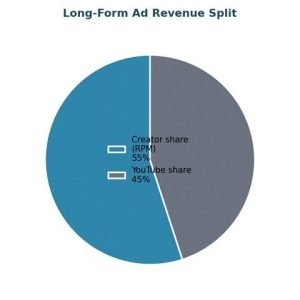
RPM stands for revenue per mille. It is what actually lands in your account per 1,000 views, after YouTube’s cut. YouTube keeps 45 percent of ad revenue on long-form video and pays creators the remaining 55 percent through RPM.RPM is always the smaller number. It is also the only figure worth planning your income around, and YouTube explains the full split in its official ad revenue analytics guide.
How Much Does YouTube Pay for 1 Million Views by Niche in 2026
Niche is the single biggest driver of your RPM. Advertisers in finance and education pay far more than advertisers in gaming or general entertainment.
| Niche | Typical RPM (2026) | Estimated Pay per 1 Million Views |
| Finance, insurance and investing | $10 to $30 | $10,000 to $30,000 |
| Tech and business | $5 to $12 | $5,000 to $12,000 |
| Education | $3 to $10 | $3,000 to $10,000 |
| Health and fitness | $2 to $7 | $2,000 to $7,000 |
| Entertainment, vlogs and gaming | $1 to $4 | $1,000 to $4,000 |
| All niche average | $2 to $8 | $2,000 to $8,000 |
These ranges are estimates built from 2026 industry benchmarks. Your own channel’s RPM will still depend on your specific audience and content style.

How Much Does YouTube Pay for 1 Million Views by Country
Where your viewers live matters as much as what you make videos about. Tier 1 countries like the United States, United Kingdom, Australia and Canada carry the strongest advertiser demand.
| Country | Typical RPM (2026) |
| United States | $7.50 to $20 |
| Australia | $8 to $13.50 |
| United Kingdom | $7 to $16 |
| Germany | $6 to $10.50 |
| India | Under $1 to $3 |
A million views from a Tier 1 audience can pay several times more than the same million views from a lower-CPM market.

What Real 2026 Data Shows About Creator Earnings
Industry-wide averages hide a lot of variation. A 2026 study tracking 300 monetised channels across 3,595 channel months found a median RPM near $2.30 for long-form video.
The same Study found Education and Science channels earning the highest median RPM of the group, at just over $10 per 1,000 views.
That gap shows why a general average is a poor planning tool. Your specific niche and audience decide your real number far more than the industry-wide figure does.
Long-Form Video vs Shorts, What Pays More

Long-form video still pays substantially more than Shorts for the same view count.
Shorts typically earn between $30 and $200 per 1 million views in 2026. That is a fraction of what long-form video earns.Shorts revenue works differently too. YouTube pools ad revenue from the entire Shorts Feed, then splits creator payouts based on their share of total Shorts views, a process covered fully in YouTube’s Shorts monetisation guidelines.
How to Qualify for YouTube Monetisation in 2026
Before any of these numbers apply to you, your channel needs to meet YouTube Partner Program thresholds
- Early access tier: 500 subscribers, 3 public videos in the last 90 days, plus 3,000 watch hours or 3 million Shorts views
- Full monetisation tier: 1,000 subscribers, plus 4,000 watch hours in the past 12 months or 10 million Shorts views in the past 90 days
- A linked AdSense account with no active Community Guidelines strikes
- Residence in a country where YouTube monetisation is available
The full requirements, including edge cases for smaller channels, are listed in YouTube’s Partner Program earnings overview. If you’re still setting up, our guide to starting a YouTube channel in the UK walks through the setup process and a realistic monetisation timeline in full.
Five Ways to Increase Your YouTube RPM
Growing your view count is only half the strategy. These five changes raise how much each view is worth.
- Extend long-form videos past the 8 minute mark to unlock mid-roll ad breaks
- Push average view duration above 55 percent to signal strong retention
- Target Tier 1 country audiences through English-language, universally relevant topics
- Turn on every available ad format in YouTube Studio, not just skippable ads
- Add sponsorships, channel memberships or affiliate links so ad revenue is not your only income
Even top creators lean on income outside ad revenue. PewDiePie has said his merchandise line now earns him more than his videos do, joking that he’s basically a hat salesman at this point. If you are weighing brand deals and other income streams for the first time, our guide to becoming a lifestyle influencer in the UK covers how to build that side of a creator income from scratch.
For a walkthrough of these tactics in action, this video is worth watching.
Conclusion
Getting 1 million views is a genuine milestone, but the payout depends on choices well within your control.Niche, audience location and video length shape your income far more than raw view count alone.Check your own RPM in YouTube Studio, then shape your content strategy around what your specific audience is actually worth.
Frequently Asked Questions
How much does YouTube pay for 1,000 views?
Most channels earn between $2 and $8 per 1,000 views in 2026, though finance and education channels often earn far more.
How much does YouTube pay for 1 million views on Shorts?
Shorts typically pay $30 to $200 per 1 million views, since Shorts revenue comes from a shared feed pool rather than direct ad placement.
What counts as a good RPM on YouTube?
Anything above the all-niche average of $2 to $8 counts as strong, though a good figure depends heavily on your niche.
Does my audience’s country affect my earnings?
Yes. Viewers in the United States, United Kingdom, Australia and Canada generate far higher ad revenue than viewers in lower-CPM markets.
Can I raise my RPM without growing my subscriber count?
Yes. Longer watch time, higher retention and enabling every ad format can raise RPM even with a stable subscriber base.

Discussion